Contents
- Strategic Context: Minot in 1968
- The Ground Reports: Before the B-52 Was Involved
- JAG-31: The B-52 Encounter
- The Radarscope Film
- The Radio Blackout
- Oscar-7: The Ground Intrusion
- Project Blue Book: Sirius, Vega and Ball Lightning
- Debunking the Blue Book Debunking
- Aftermath and Legacy
- The Unanswered Questions
- Primary Documents
- Cold War UFO Case Files Series
- FAQ
At 02:30 on the morning of October 24, 1968, security personnel across the November flight missile complex at Minot Air Force Base began reporting an anomalous luminous object to Base Operations. By the time the sun rose, that object had been observed from multiple independent ground locations, tracked on ground radar, confirmed on the radarscope of a Strategic Air Command B-52H, and corroborated by recorded radio communications. The incident generated over a hundred pages of official documentation and was dismissed by Project Blue Book as a combination of a twinkling star, a passing planet, and a form of ball lightning that was never measured, never identified, and never actually observed at the scene.
What distinguishes Minot in the Cold War UAP record is not simply that it happened, but what survived it. Unlike most incidents that rest on eyewitness memory alone, the Minot case has surviving radarscope photographs, recorded radio communications between the B-52 crew and ground controllers, official AF-117 witness statement forms filed within hours of the event, and a Blue Book case file that, in attempting to explain the incident away, inadvertently documented how comprehensive and credible the original reports actually were. Thomas Tulien's reconstruction of the case through the Sign Oral History Project, drawing on declassified records and direct interviews with surviving witnesses, remains the most thorough analysis of any single Cold War UAP event in the public domain.
Strategic Context: Minot in 1968
Minot Air Force Base, on the flat expanse of north-central North Dakota, was in 1968 one of the most strategically critical installations in the US nuclear arsenal. It was home to the 5th Bombardment Wing, operating B-52H Stratofortress strategic bombers on continuous alert, and to the 91st Strategic Missile Wing, whose Minuteman ICBM squadrons were dispersed across fifteen Launch Control Centers covering thousands of square miles of North Dakota farmland. Minot was a dual-mission base, one of very few in the country, with nuclear bombers and nuclear missiles under one command.
The October 1968 incident occurred at a particularly sensitive moment: the United States was in the final months of a year that had seen the Tet Offensive, the assassination of Robert Kennedy, and the Soviet invasion of Czechoslovakia. Strategic nuclear readiness was at a premium. The personnel of the 91st Strategic Missile Wing, manning remote Launch Control Centers across the North Dakota plains, were not edgy amateurs. They were rigorously selected, continuously evaluated, and trained to maintain composure under extreme pressure. Their reports, filed formally and promptly, carry the credibility that comes with that training.

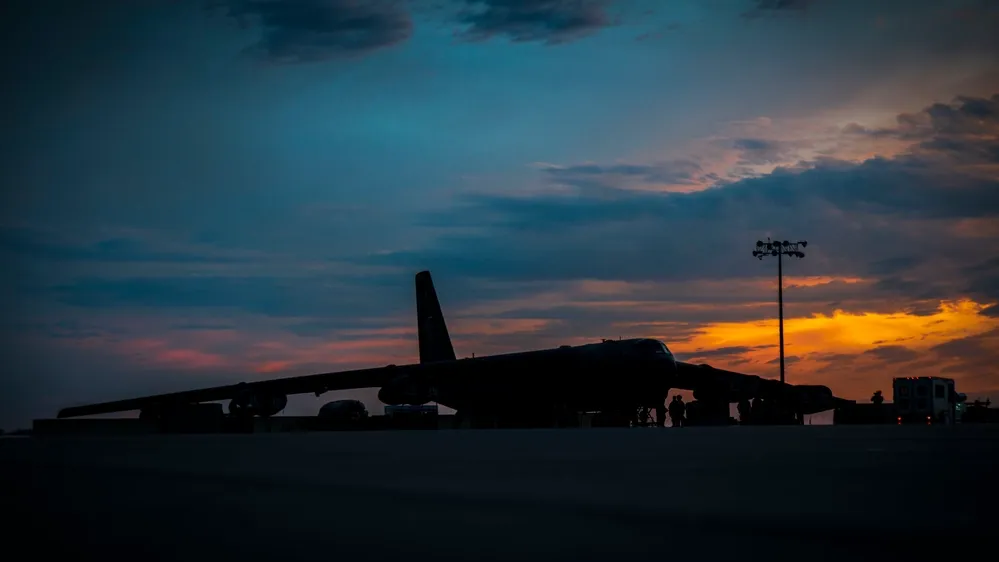
A B-52H Stratofortress of the type operated by the 5th Bombardment Wing at Minot AFB. On October 24, 1968, the B-52H designated JAG-31 was directed by ground controllers to investigate an unknown radar contact, and produced one of the most thoroughly documented airborne UAP encounters in military history. Image: U.S. Air Force / Public Domain.
The Ground Reports: Before the B-52 Was Involved
The Minot incident did not begin with the B-52. It began on the ground, in the pre-dawn darkness, as security and maintenance personnel across the November flight area began reporting unusual lights to Base Operations. The reports came from multiple independent locations, separated by miles of open farmland, with no means of coordination between observers. They described a luminous object, at times appearing as a large ball of white light shifting through green and amber, at others appearing to divide into two separate objects, moving low over the missile complex in silence.
Airman First Class O'Connor, stationed at one of the remote sites, filed an AF-117 witness form describing a large, self-luminous ball of white light that changed colour progressively, white to green to dim amber, over a period of more than an hour beginning around 02:30. Other ground personnel filed similar statements, each independently corroborating the presence of an anomalous light source operating low over the missile field before the B-52 was ever redirected. Base Operations, tracking the incoming reports from multiple sites, initiated radio communications with ground personnel, Minot Radar Approach Control, and the crew of JAG-31.
JAG-31: The B-52 Encounter
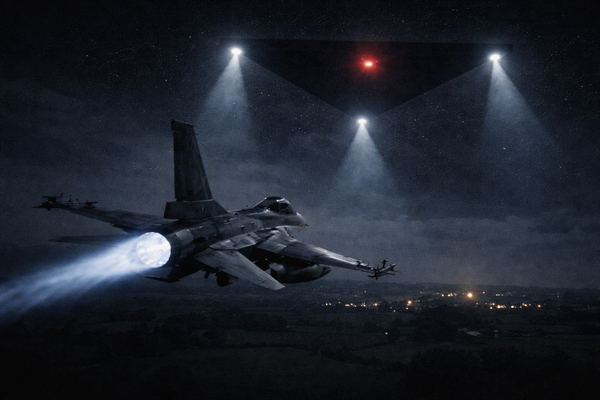
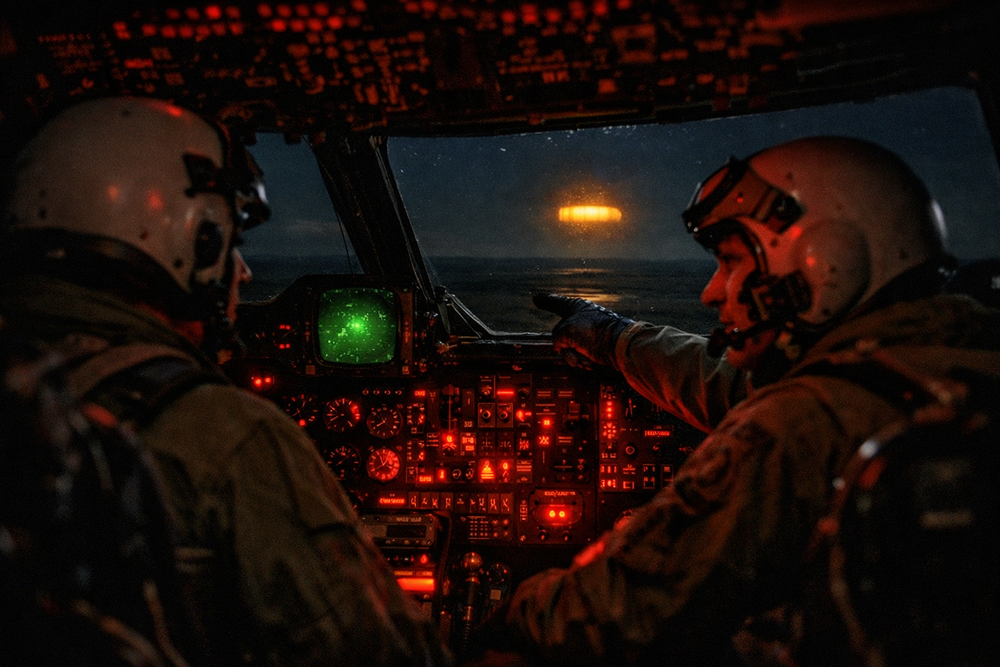
B-52H call sign JAG-31, with Major James Partin as aircraft commander and co-pilot Bradford Runyon among the crew, was completing a standard ten-hour Combat Crew training mission when Minot RAPCON advised them of unidentified traffic and asked them to keep their eyes open. Navigator Patrick McCaslin focused the aircraft's radar into a narrow high-intensity beam and picked up a return to the right of the aircraft, faint on the first sweep and very strong on the second.
RAPCON confirmed the object on ground radar and provided its bearing. As JAG-31 executed a standard 180-degree turnaround, McCaslin tracked the object on radarscope maintaining a consistent three-mile distance throughout the manoeuvre, behaviour that ruled out a ground return or weather phenomenon and implied something actively maintaining station relative to the aircraft. As the B-52 began its descent back toward Minot, the object closed rapidly to approximately one nautical mile and paced the aircraft for nearly twenty miles before disappearing from the radarscope.
Co-pilot Bradford Runyon, in a witness account filed with the Centre for UFO Studies in 2000, described the object becoming visible to the crew visually as they descended: a metallic cylinder with a crescent moon-shaped section glowing yellow-green, several hundred feet in length, glowing orange like molten steel. This description has remained consistent across multiple retellings over thirty years. Major Partin separately described seeing what looked like a miniature sun placed on the ground below the aircraft on approach, an image vivid enough to remain unaltered in his memory for decades.
“It blew my mind that this thing had closed on us this quickly. We could hear the tower, but they couldn’t hear us. And then the object just dropped off the radar. That’s when the pilots said — ‘Why don’t you unstrap and come up and take a look at this thing?’”
— Captain Patrick McCaslin, B-52H Navigator, JAG-31
On-record interview, cited in reporting by The Forum (Fargo, ND), first published 23 October 2008. Also referenced in Thomas Tulien, Investigation of UFO Events at Minot AFB, Sign Oral History Project (2011).
The Radarscope Film
Of all the evidence the Minot incident produced, the radarscope film is the most resistant to conventional explanation. Fourteen frames of the B-52's ASQ-38 bombing navigation radar display were photographed between approximately 09:06:14Z and 09:06:51Z, a period of 37 seconds during the close approach phase. Staff Sergeant Richard Clark, the targeting studies officer tasked with analysing the film, had two sets of prints made, forwarding one up the chain of command to Strategic Air Command headquarters and retaining a second set for himself, a decision that has proven historically significant.
Independent technical analyses of the radarscope photographs, conducted by French scientist Dr. Claude Poher and by Scottish radar analyst Martin Shough as part of Tulien's Sign Oral History Project investigation, identified a compact radar echo appearing consistently near one nautical mile from the aircraft in the two o'clock quadrant across multiple frames, sometimes as a double return separated by a fraction of a mile. Both analysts concluded it was inconsistent with a ground return, atmospheric clutter, or any known instrumental artefact. This is not eyewitness memory. It is instrument data, captured on film, independently analysed by qualified technical specialists, and available in the public record.
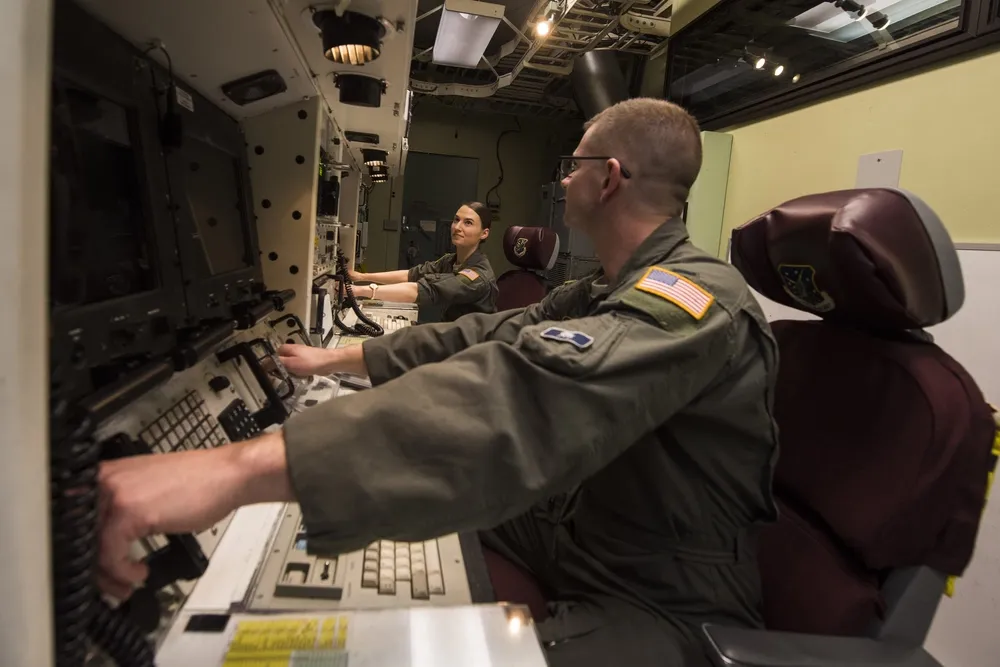
Minot Air Force Base, North Dakota, a dual-mission Strategic Air Command installation housing both B-52H strategic bombers and Minuteman ICBM squadrons. In October 1968 it was one of the most heavily defended nuclear installations in the world. Image: U.S. Air Force / Public Domain.
The Radio Blackout
At the moment of closest radar approach, both of JAG-31's UHF radios ceased to transmit. The crew could receive transmissions from Minot RAPCON clearly but could not respond, and the outage lasted approximately two minutes, timestamped in the Blue Book case file's own timeline as occurring between 04:00 and 04:02, precisely coinciding with the close approach phase captured in the radarscope photographs. At 04:02, as the object departed the radarscope, transmission capability was restored.
This is not a detail that rests on memory or interpretation. It is documented in the official Air Force record, with a specific timestamp in a specific document. The Blue Book case file itself, the document designed to explain the incident away, acknowledges the radio outage and attributes it to plasma, while offering no evidence of plasma in the vicinity, no measurement of any plasma effect, and no mechanism by which ball lightning at an unspecified location could selectively disable UHF transmission equipment aboard a specific aircraft at a moment that correlates precisely with the closest radar approach of an unidentified object, a correlation that is not a researcher's inference. It is in the government's own paperwork.
- Multiple ground observers across the November flight ICBM complex reported an anomalous luminous object from approximately 02:30, filing independent AF-117 witness forms
- B-52H JAG-31 directed by Minot RAPCON to investigate; navigator McCaslin obtained radar contact confirmed simultaneously on ground radar
- Object maintained consistent three-mile distance during B-52 180-degree turnaround, then closed to one nautical mile and paced aircraft for approximately twenty miles
- 14 frames of radarscope film captured during close approach; independent technical analyses by Poher and Shough identify anomalous compact echo inconsistent with known artefacts
- Both B-52H UHF radios ceased transmitting during close approach, restoring function at 04:02 as object departed, timestamped in Blue Book's own case file
- Oscar-7 Launch Facility reported outer zone security alarm activation during the incident; physical damage found at the site on subsequent investigation
- Blue Book case file exceeds 100 pages including radio transcripts, radar data, witness forms and flight telemetry
- Blue Book conclusion: star Sirius, star Vega, ball lightning, and B-52 landing lights. No conventional explanation adequately engages the instrument evidence
Oscar-7: The Ground Intrusion
While JAG-31 was conducting its aerial encounter, events were unfolding on the ground at Oscar-7, one of the Minuteman ICBM Launch Facilities within the 91st Strategic Missile Wing's complex. During the hours of the incident, Oscar-7 reported activation of its outer zone security alarm, the system designed to detect intrusion into the restricted area surrounding the launch facility. When a team was dispatched to investigate the following afternoon on the orders of the Wing commander, they found a vehicle at the site with physical damage.
The Oscar-7 element has been subject to significant debate in the research literature, and precision is required. What the documents establish is that an alarm was triggered at a nuclear missile facility during the same period as the aerial incident, and that physical evidence of something was found at the site, though what caused the alarm activation and what damaged the vehicle has never been officially explained. Tulien's investigation treats Oscar-7 with appropriate caution, noting it as a documented anomaly that warrants scrutiny but declining to go beyond what the record sustains. That restraint makes the documented facts more troubling, not less.
Project Blue Book: Sirius, Vega and Ball Lightning
Blue Book chief Lieutenant Colonel Hector Quintanilla filed the final case report on November 13, 1968, less than three weeks after the incident. His conclusions divided the event into component parts and attached a familiar explanation to each. Ground visual sightings were attributed to the star Sirius and the B-52's own approach and landing lights. The pilot's visual of an orange light near the ground was attributed to the star Vega near the horizon, or to an unspecified light on the ground, while the radar contact and the radio transmission failure were both attributed to plasma similar to ball lightning.
Blue Book's index card for the case lists the conclusion as “Identified (Other) by Radar Analysis as plasma,” placing the Minot case in the “identified” column of official statistics. An incident with over a hundred pages of documentation, multiple independent witnesses, instrument-corroborated radar data, and a precisely timestamped communications anomaly was, for official purposes, resolved. The resolution was a star and a form of atmospheric electrical discharge that has never been observed to disable aircraft communications, maintain station relative to a moving aircraft, or appear as a compact, persistent echo on a calibrated military radarscope.
Debunking the Blue Book Debunking
The Blue Book conclusions have been subject to detailed independent scrutiny by Tulien, Poher, Shough, and Kevin Randle, and have been found wanting on multiple grounds.
Ground Visual Sightings: The Star Sirius and the B-52
Quintanilla proposed that ground observers were seeing Sirius, enhanced by atmospheric haze and inversion layers, possibly combined with the B-52's own lights. This fails on several grounds. Personnel stationed at remote missile sites on extended night shifts were intimately familiar with the night sky and routine aircraft movements. The suggestion that trained military professionals could not distinguish between a fixed scintillating star and a low-altitude object that changed colour, moved across the sky, and was observed for over an hour is a statement of institutional condescension, not a scientific conclusion. Multiple witnesses also noted complete cloud cover, making stellar observation impossible at their locations. A fixed star cannot account for objects tracked moving across the horizon by observers reporting overcast conditions, and Sirius does not pace a B-52 across twenty miles of North Dakota airspace or appear on a calibrated military radarscope.
Final Thoughts: cannot account for cloud-obscured observations, object movement, or radar returns. Fails geometric consistency with the documented flight track.
Air Visual: The Star Vega
Major Partin's description of seeing what appeared to be a miniature sun placed on the ground below the aircraft was attributed by Quintanilla to Vega near the horizon, or possibly an unidentified ground light. Vega is a point source at astronomical distance and does not appear to rest on the ground below a descending aircraft or produce the impression of a concentrated, intensely luminous disc. Quintanilla's own filing concedes uncertainty with the hedge “or it could be a light on the ground,” while identifying no actual source for an unusually bright ground-level light in the area below the flight path. An explanation that cannot identify what it claims to identify is a placeholder.
Final Thoughts: Vega cannot produce the visual impression described. No ground-based light source was ever identified.
Radar Contact and Radio Outage: Plasma
This is the most consequential and least defensible of Blue Book's conclusions. Quintanilla proposed that both the radarscope contact and the two-minute UHF transmission failure could be attributed to plasma similar to ball lightning. Three problems undermine it immediately. First, no plasma was detected or measured at Minot on October 24, 1968; it is invoked here as a hypothesis, not a diagnosis. Second, ball lightning has never been documented producing a stable, compact, directionally consistent radar return across 14 photographic frames over 37 seconds while maintaining station relative to a moving aircraft. Third, as Poher noted in his independent analysis, an electromagnetic explanation for the radio outage, a zone of ionised air surrounding the object, is at least physically coherent, but makes the case more anomalous, not less. Blue Book offers no mechanism, no evidence, and no physical basis beyond the word “plasma.”
Final Thoughts: no plasma detected or measured. Ball lightning cannot produce stable directional radar returns or disable aircraft communications in documented proximity to an unidentified contact. The claim has no evidentiary basis.
Methodology: Decomposing the Event
The most revealing aspect of the Blue Book Minot analysis is its method. Quintanilla decomposed the incident into discrete, separable elements and attached a familiar explanation to each in isolation, a framework that deliberately avoids the central question: what accounts for all of these elements simultaneously? A star cannot explain both a radar return and a radio outage. Ball lightning cannot explain both a directional radar contact and extended visual observations by ground personnel across multiple locations. Taken as a whole, the incident is a multi-platform, multi-sensor, multi-witness event with instrument corroboration, and Blue Book's institutional mandate was not to engage with it as such. The Minot case file documents that failure in exhaustive detail.
Final Thoughts: the methodology was designed to produce individually plausible explanations for isolated elements, not to account for the convergence of evidence. The case has not been explained; it has been administratively closed.
Aftermath and Legacy
The Minot incident sits within a pattern spanning both sides of the Cold War. It followed the Malmstrom missile shutdown of 1967 by eighteen months and preceded the Tehran intercept of 1976, in which two F-4 Phantoms experienced identical proximity-correlated systems failures while attempting to engage an unidentified object, by eight years. The communications blackout aboard JAG-31, timestamped in Blue Book's own paperwork, is the same signature that appears at Rendlesham in 1980 and at the Soviet missile base incident of 1982.
In the immediate aftermath, JAG-31's crew was debriefed the moment the aircraft landed, by Base Operations commander Colonel Ralph Kirchoff and by Brigadier General Ralph Holland, commanding the 810th Strategic Aerospace Division. Strategic Air Command headquarters contacted Blue Book the following business day to ensure correct procedures were being followed. Lieutenant Colonel Arthur Werlich, the base's designated UFO investigation officer, requested technical assistance from SAC to analyse the radarscope film and was denied, being instructed instead to comply with Air Force Regulation 80-17 and submit the standard documentation package.
Clark's retained prints, recovered by researchers decades later, provided the high-quality images that made independent technical analysis by Poher and Shough possible. Without that act of unofficial preservation, the radarscope evidence might have been permanently inaccessible, and it is a detail in the broader pattern of how the documentary record of these incidents survives: often by accident, often through the initiative of individuals who sensed something important was being buried.
“Quintanilla’s conclusions were typical of the methods and faux science the Air Force employed to eliminate unidentified reports and reassure the public of the lack of evidence behind UFOs. For over two decades the policy was successful, and continues to reinforce a prohibition on taking UFOs seriously.”
— Thomas Tulien, Sign Oral History Project
Investigation of UFO Events at Minot Air Force Base, North Dakota, Section 6: Project Blue Book Evaluation. minotb52ufo.com (2011).
A Minuteman ICBM Launch Facility on the North Dakota plains, one of dozens operated by the 91st Strategic Missile Wing from Minot AFB. Ground personnel at multiple sites across this complex reported the anomalous object independently, before the B-52 crew was ever involved. Image: U.S. Air Force / Public Domain.
The Unanswered Questions
The Minot case has been more thoroughly investigated by independent researchers than almost any other Cold War UAP incident, and the core questions have never received a credible official answer. Fifty-six years after the event, the following remain without resolution.
- What was the compact, persistent radar echo captured across 14 frames of the B-52's radarscope film, and why does Blue Book's own description not match the physical characteristics of plasma or any known atmospheric phenomenon?
- What caused the simultaneous loss of both UHF radios on JAG-31 at the precise moment of closest radar approach, and what physical mechanism connects this to the ball lightning explanation?
- What triggered the outer zone security alarm at Oscar-7 during the incident, and what caused the physical damage found at the site?
- Were there events during the Minot episode, as researcher Bill McNeff stated, that did not make it into the Blue Book files?
- What did the full set of radarscope prints forwarded to SAC headquarters reveal, and where are they now?
- Why was Werlich denied technical assistance for his investigation, and who made that decision?
Primary Documents & Further Research
- Sign Oral History Project — Full Minot Investigation (minotb52ufo.com) Thomas Tulien's exhaustive reconstruction of the case. The definitive research resource, including radarscope frame analysis, witness interviews, radio transcripts and Blue Book evaluation.
- Section 6: Project Blue Book Evaluation — Tulien Analysis Detailed forensic analysis of Quintanilla's conclusions against the primary evidence. Essential reading for understanding the institutional failure the Minot case represents.
- UAPedia — Minot Air Force Base Incident (1968) Comprehensive reference entry drawing on the full body of declassified documentation, including radarscope frame descriptions and communications timeline.
- The Investigation of UFO Events at Minot AFB — Academic Paper (Tulien, Academia.edu) Peer-reviewed academic reconstruction of the Minot case, contextualising the incident within Cold War defence policy and institutional attitudes toward UAP.
Cold War UFO Case Files Series
The Minot incident is the second case in the Stranger Times Cold War UFO Case Files series. It shares significant structural similarities with the Malmstrom missile shutdown of 1967: a Strategic Air Command installation, nuclear assets in proximity, multiple trained military witnesses, instrument corroboration, and an official investigation that failed to engage honestly with the evidence it gathered. Each article in the series examines a distinct encounter in the same depth: primary sources, witness testimony, official response, and the sceptical arguments that have been tested against the evidence.
- Case 01 · Malmstrom AFB Missile Shutdown, USA — 1967
- Case 02 · Minot AFB Encounter, USA — 1968 (This Article)
- Case 03 · Tehran Phantom Intercept, Iran — 1976
- Case 04 · Rendlesham Forest Incident, UK — 1980
- Case 05 · Soviet Missile Base Incident, USSR — 1982
- Case 06 · Belgian UFO Wave — 1989–1990
Frequently Asked Questions
What is the strongest piece of evidence in the Minot case?
The radarscope film. Fourteen frames of instrument data captured by the B-52's ASQ-38 radar, independently analysed by qualified technical specialists, showing an anomalous compact echo inconsistent with any known atmospheric or instrumental artefact. Unlike eyewitness testimony, instrument data does not misremember or embellish. The Minot radarscope photographs are the evidentiary foundation of the case.
Was Blue Book's ball lightning explanation credible?
No. Ball lightning was proposed as the explanation for both the radar contact and the radio outage, but no plasma was detected or measured at Minot on the night in question. The explanation was not a diagnosis; it was a hypothesis deployed to close a case. Ball lightning has never been documented producing stable directional radar returns or selectively disabling aircraft communications in correlation with a specific unidentified radar contact.
How does Minot compare to Malmstrom?
Both incidents occurred at Strategic Air Command bases with Minuteman ICBM assets, within eighteen months of each other, involving multiple trained military witnesses and instrument corroboration. Malmstrom is distinguished by the weapons system interference, ten ICBMs simultaneously disabled. Minot is distinguished by the quality of its instrument evidence, radarscope film and recorded radio communications. Together they form a pattern of UAP activity over US nuclear installations that has never been officially acknowledged.
Where can I read the primary documentation?
Thomas Tulien's Sign Oral History Project investigation at minotb52ufo.com is the most comprehensive public resource. It includes the declassified Blue Book case file, radio transcripts, witness statements, radarscope frame analysis, and the full independent technical assessments by Poher and Shough.
Sources
- Tulien, Thomas. Investigation of UFO Events at Minot Air Force Base, North Dakota. Sign Oral History Project. minotb52ufo.com, 2011.
- U.S. Air Force. Project Blue Book Case File: Minot AFB, October 24, 1968. Final Report by Lt. Col. Hector Quintanilla, November 13, 1968. Declassified; available via National Archives.
- Poher, Claude. Analysis of Radar and Air-Visual UFO Observations on 24 October 1968 at Minot Air Force Base, ND. 2005. Translated and published via Sign Oral History Project.
- McCaslin, Patrick. On-record interview. The Forum (Fargo, ND), first published October 23, 2008.
- Runyon, Bradford Jr. CUFOS UFO Sighting Questionnaire, February 11, 2000. Referenced in Sign Oral History Project.
- Tulien, Thomas & Klotz, James (eds.). A Narrative of UFO Events at Minot Air Force Base, North Dakota. Academia.edu, 2025.
- Kean, Leslie. UFOs: Generals, Pilots, and Government Officials Go On the Record. Harmony Books, 2010.
- Hastings, Robert. UFOs and Nukes: Extraordinary Encounters at Nuclear Weapons Sites. AuthorHouse, 2008.
— End of Case File · Minot AFB 1968 —
Research drawn from declassified Project Blue Book documentation, FOIA-obtained records,
the Sign Oral History Project investigation, and on-the-record testimony from named former military personnel.
Part of the Stranger Times Cold War UFO Case File series.