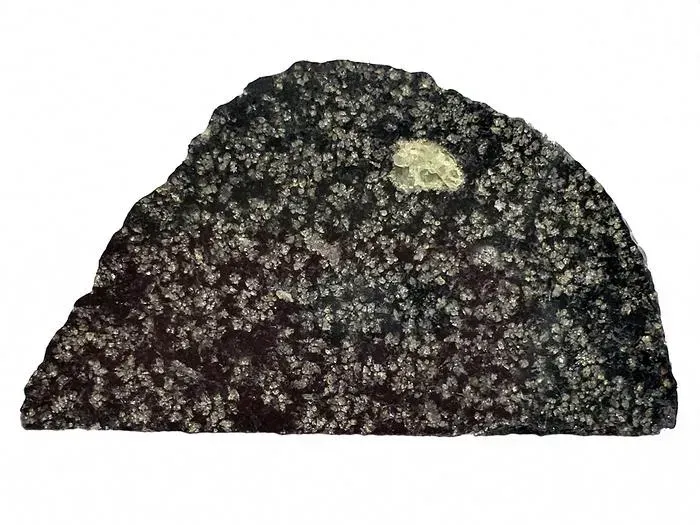
A rare meteorite recovered from the Sahara Desert is providing scientists with a remarkable glimpse into a vanished world that may have existed during the earliest days of the Solar System.
Researchers studying the meteorite, known as Northwest Africa 12264, believe it originated from a long-lost protoplanet, one of the building blocks from which larger planets eventually formed. The findings offer a rare opportunity to examine material from a planetary body that no longer exists.
The meteorite was discovered in Algeria in 2018 and has since become the subject of detailed analysis. Unlike most meteorites, which can often be linked to known parent bodies such as the Moon, Mars or specific asteroid groups, this specimen appears to come from a source that has yet to be identified.
Scientists found that the rock contains an unusual mixture of minerals and isotopic signatures that do not closely match any known meteorite class. According to the research team, the meteorite likely formed within a differentiated planetary body, a world large enough for its interior to separate into layers such as crust, mantle and core.
Such objects were common during the chaotic early history of the Solar System more than 4.5 billion years ago. Astronomers believe dozens, and possibly hundreds, of protoplanets emerged as dust and rock collided around the young Sun. Many of these worlds were later destroyed through violent impacts or absorbed into larger planets during the formation of the Solar System.
The discovery is significant because direct evidence of these lost worlds is exceptionally rare.
Most surviving planetary bodies have been heavily altered by billions of years of collisions, volcanic activity and geological change. Meteorites such as Northwest Africa 12264 act as time capsules, preserving chemical information from an era before Earth itself had fully formed.
Researchers suggest the meteorite may have originated from a protoplanet that developed relatively quickly before being shattered during one of the enormous collisions that characterised the Solar System's infancy. Fragments of that world were subsequently scattered across space, with one eventually finding its way to Earth.
The study also contributes to a growing recognition that the early Solar System was far more diverse than previously understood. Over the past two decades, advances in meteoritics have revealed evidence for numerous ancient planetary bodies that no longer survive as distinct worlds. Instead, their existence is preserved only in fragments embedded within meteorites.
Some scientists compare these discoveries to finding fossils from extinct species. Just as a fossil can reveal a lost branch of evolutionary history, unusual meteorites can expose planetary lineages that vanished billions of years ago.
The research highlights how much remains unknown about the Solar System's formative years. While modern astronomy can observe planets orbiting distant stars across the galaxy, many mysteries about our own cosmic origins remain unresolved.
For now, the Sahara meteorite offers a tantalising reminder that the Solar System we see today is only the surviving remnant of a much larger and more chaotic family of worlds. Hidden within ancient meteorites may be the final traces of planets that formed, evolved and disappeared long before Earth became the world we know.
The discovery also echoes one of the most persistent ideas in both mythology and alternative history: the existence of lost worlds that vanished during the formation of the Solar System. While the research has no connection to the legendary planet "Tiamat" proposed by ancient astronaut writer Zecharia Sitchin, modern planetary science does support the existence of numerous protoplanets that formed and were later destroyed in colossal collisions billions of years ago.
In an unexpected way, meteorites such as Northwest Africa 12264 provide tangible evidence that entire worlds once existed and disappeared, leaving behind only scattered fragments to tell their story.
Source: Smithsonian Magazine