The Complaint That Changed Everything
On a morning in July 2021, a GS-15 civilian employee of the National Geospatial-Intelligence Agency sat down and filed a classified disclosure with the Department of Defense Inspector General. The document alleged that certain elements of the Intelligence Community had been withholding UAP-related material from congressional oversight and had been doing so with intent. Within weeks, the same employee began experiencing the cancellation and obstruction of his compartmented clearances. By August 2022, he had received formal notice of full revocation, been removed from classified systems, ordered to surrender his access badges, and placed on administrative leave. By December 2022 the final revocation letter was signed.
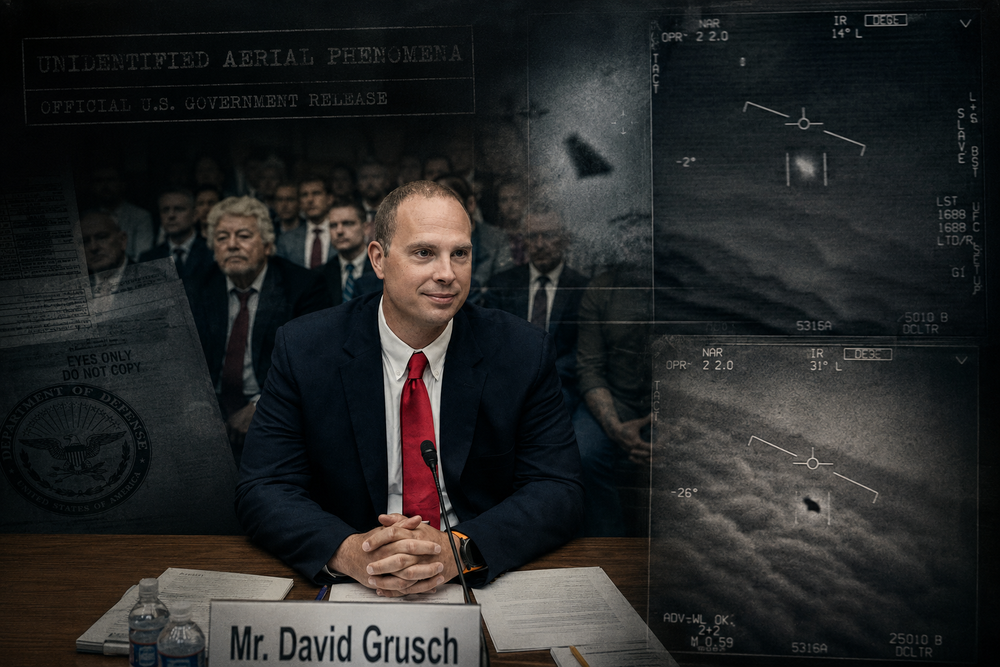
That employee was David Charles Grusch. The sequence of events between his disclosure and final revocation would become the central documented fact around which the most consequential public dispute about UAP in a generation would turn.
Who Is David Grusch?
Grusch is a decorated Air Force combat veteran of the Afghanistan campaign, a career intelligence officer, and a holder of Top Secret/SCI clearances. He served as the National Reconnaissance Office's representative to the Unidentified Aerial Phenomena Task Force from 2019 to 2021, and subsequently as the NGA's co-lead for UAP analysis and Task Force representative. Those are not entry level positions. The UAPTF was a formally constituted DoD body reporting upward through the Office of the Director of National Intelligence; Grusch's role gave him authorised access to a broad range of UAP-related reporting.
Grusch has described how his initial reaction to the material which he began encountering was scepticism. Senior intelligence officials he had known throughout his career began approaching him with accounts of programmes to which the Task Force had not been given access. They provided documents and named programmes. By his own account, the doors that opened were unexpected, and the doors that slammed shut were deliberate.
"I thought it was totally nuts. I thought at first I was being deceived."
David Grusch — NewsNation, 2023
His attorney for the IC Inspector General complaint was Charles McCullough III, the former Inspector General of the Intelligence Community under both Obama and Trump, a choice of counsel which was was not incidental.
The Congressional Hearing: July 26, 2023
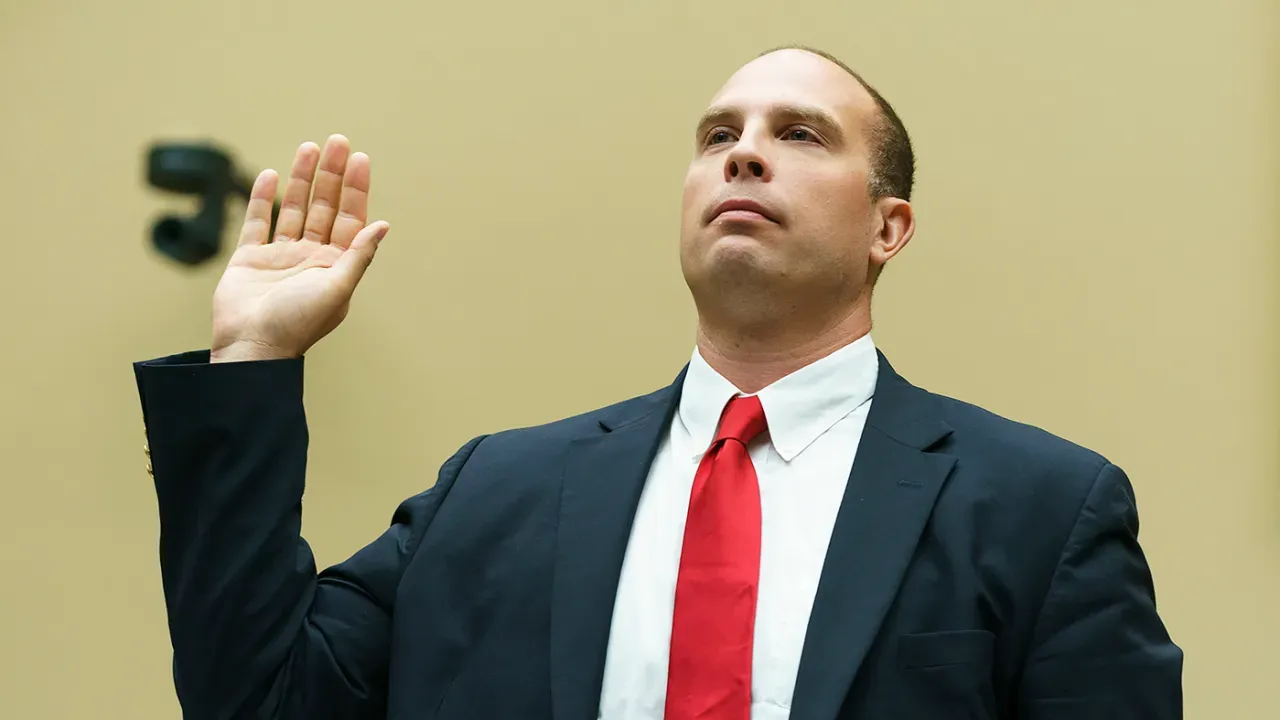
By the time Grusch testified publicly before the House Oversight Committee's Subcommittee on National Security, the Border, and Foreign Affairs on July 26, 2023, his claims had already been published by The Debrief and cleared for public release by the DoD's DOPSR (Defense Office of Prepublication and Security Review). The DOPSR clearance did not confirm his claims were true. It merely confirmed they contained no currently classified material,an altogether different but nonetheless significant fact.
Under oath, Grusch told the committee he had been informed through his official duties of a multi-decade UAP crash retrieval and reverse-engineering programme to which he had been denied access. He stated that the government was in possession of UAP based on interviews with approximately forty witnesses conducted over four years, and that the assessment of those with direct programme knowledge was that non-human biologics had been recovered from craft.
"A multi-decade UAP crash retrieval and reverse-engineering program" — to which he had been denied access. When asked whether he had personal knowledge of people harmed in efforts to conceal UAP technology, Grusch said yes.
David Grusch — House Oversight Committee, 26 July 2023
At the Committee Grusch was joined by two former Navy pilots whose testimony came from a different evidentiary backgrounds. Commander David Fravor described his 2004 encounter with an object exhibiting flight characteristics that, as he put it, were "far superior to anything that we had." Ryan Graves testified that UAP activity off the Atlantic Coast had been routine, not exceptional, among active-duty naval aviators. Fravor and Graves were describing encounters they had lived through; Grusch was relaying what sources had told him about programmes he had never been given access to. That gap between direct observation and attributed testimony is important to evaluating Grusch's claims, and the sceptical literature is right to scrutinise it.
Former DoD intelligence official Luis Elizondo, testifying at a subsequent 2024 hearing, was asked by Burchett whether he agreed with Grusch's claim that a multi-decade crash retrieval and reverse-engineering programme existed. Elizondo said yes. When asked whether UAP programmes were operating without proper congressional oversight, Elizondo answered:
"100%."
Luis Elizondo — House hearing, 2024, on whether UAP programmes were operating outside congressional oversight
Although this is not proof. Named, credentialled testimony on the congressional record,counts for something.
The Retaliation Files
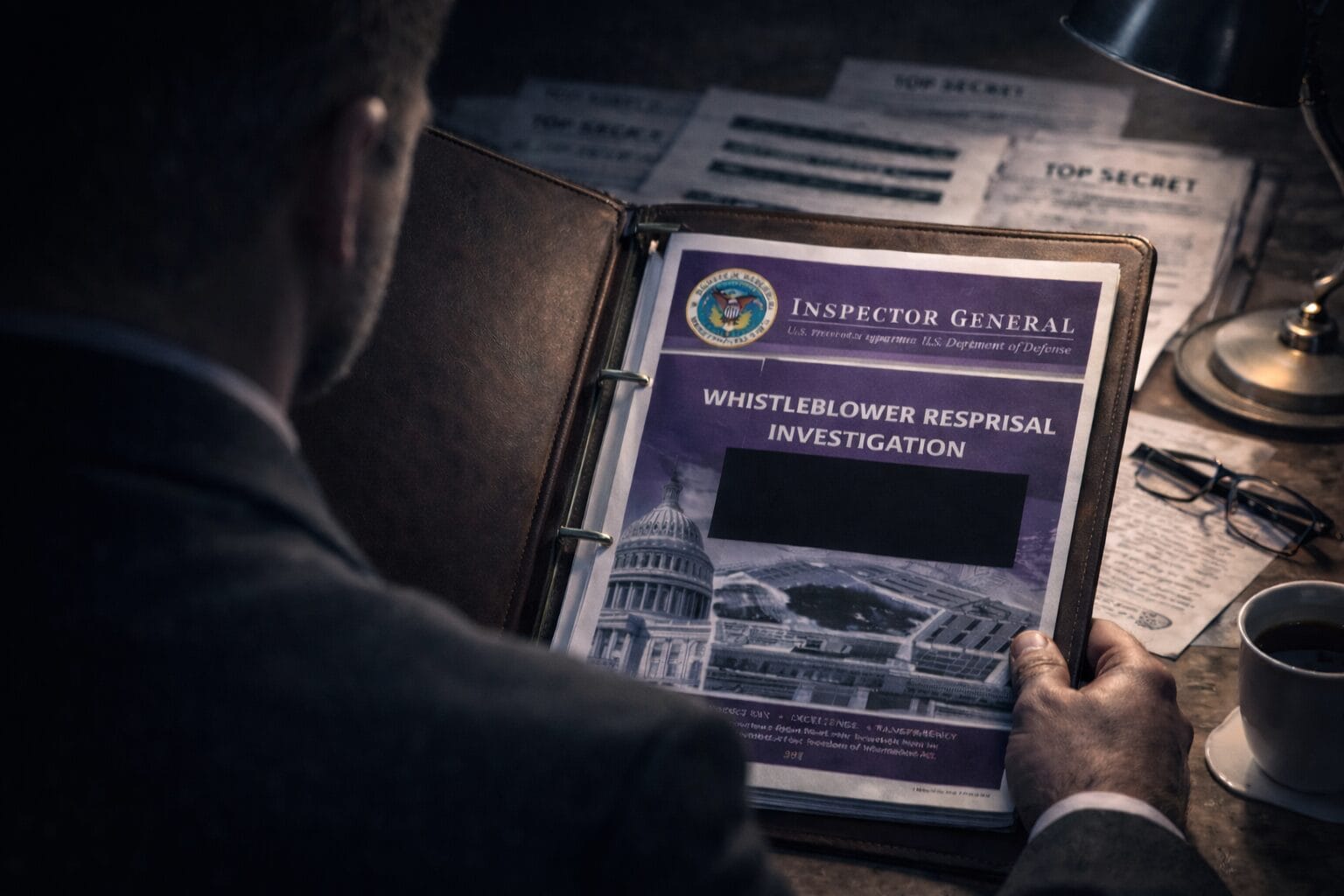
The DoD Inspector General's reprisal investigation into Grusch's clearance revocation was released in heavily redacted form on January 7, 2026. The report does not name Grusch as the complainant, but the chronology, subject matter, and procedural structure align with the publicly documented record of Grusch's case at every comparable point. The Black Vault, which obtained the documents via FOIA, noted that it had requested all Inspector General complaints referencing whistleblowers who reported UAP-related programmes from January 2021 to present. One case was returned.
The report confirms that the complainant “made four protected disclosures”, including one to the DoD Inspector General, and that the actions which followed, including the revocation of his security clearance and removal from classified systems, became the subject of a formal reprisal investigation. The clearance was later restored on appeal. In February 2025, the DoD IG closed the case without finding evidence of reprisal. Whether that outcome reflected the absence of retaliation or the inherent difficulty of proving it within a process overseen by the same institutional structure under scrutiny is impossible to determine from the heavily redacted report alone.
What can be said plainly is this: a senior intelligence officer filed a classified disclosure about UAP programme concealment from Congress, and within thirteen months he had been stripped of his clearances and removed from classified work. The official explanation is that those two events are unconnected.
Immaculate Constellation
In October 2024, journalist Michael Shellenberger published a report citing a new whistleblower source who described a classified Special Access Programme named Immaculate Constellation, said to manage UAP-related intelligence collection and retrieval. The DoD responded that it had "no record, present or historical, of any type of SAP called 'Immaculate Constellation.'" That denial was entered into the congressional record at a November 2024 hearing, where Representative Anna Paulina Luna read the name aloud and noted, drily, that she expected it would put her on some kind of list.
The Pentagon's denial has a specific structure. It states the department has no record of a SAP by that name. An unacknowledged SAP, by definition, would not appear in accessible departmental records. The denial neither confirms nor refutes the substance of the allegation; it simply describes the architecture of classification, which is that the most sensitive programmes are specifically designed not to appear in the records that would be searched in response to a congressional query or FOIA request.
Grusch, in his own congressional testimony, had separately described programmes fitting this description, in which crash-retrieval-related material was routed through contractor-operated unacknowledged SAPs specifically to keep it out of AARO's reach and away from congressional oversight. The Pentagon FOIA response on Immaculate Constellation, declining to confirm any search of its files had been conducted, arrived in February 2026 and confirmed only that the department was declining to engage.
- Grusch filed a classified DoD IG disclosure in July 2021; his clearances were revoked by December 2022.
- The DoD IG confirmed four protected disclosures were made and a formal reprisal investigation was opened, then closed without finding reprisal in February 2025.
- The Pentagon has declined to confirm any FOIA search was conducted for Immaculate Constellation programme records.
- Former ICIG Charles McCullough III represented Grusch in the IC Inspector General complaint.
- Luis Elizondo confirmed under oath that UAP programmes operate outside congressional oversight.
- The ODNI acknowledged a pattern of intimidation directed at disclosure witnesses in a 2023 committee disclosure.
The Architecture of Suppression
The case Grusch and subsequent witnesses have assembled is not, at its core, an argument about whether UAPs are extraterrestrial. It is an argument about how information is structurally prevented from moving upward through oversight channels.
The mechanism he described has five identifiable components, each of which has been partially corroborated by separate reporting. First: compartmented operations are routed through private defence contractors rather than through government agencies, placing them outside AARO's statutory reach and outside the classification authorities that congressional oversight committees can compel disclosure from. Second: the UAP-related intelligence function was controlled for nearly a decade by a single gatekeeper within the Pentagon's bureaucracy, a bureaucratic chokepoint that independent reporting subsequently confirmed. Third: witnesses with direct knowledge of these activities who attempted to approach disclosure channels were subjected to what the ODNI itself, in a 2023 committee disclosure, acknowledged was a pattern of intimidation. Fourth: FOIA searches for key programme names, including Immaculate Constellation, have been declined on procedural grounds that effectively render them undisclosable through public channels. Fifth: at least one former USAF intelligence officer connected to UAP work died before providing anticipated testimony in May 2026, adding his name to a growing list of strange deaths among defence contractors with reported connections to these activities, a pattern Stranger Times News has been tracking.
None of these five components, taken individually, constitutes proof of a deliberate suppression campaign. Taken together, as a documented sequence, they describe an institutional architecture in which information moves in one direction and stops when it reaches oversight.
The April 2026 allegation that ODNI ran a covert intimidation campaign against disclosure witnesses represents, if accurate, the most direct confirmation of active suppression rather than passive bureaucratic obstruction. That investigation remains active at time of publication.

Within the last week, a further data point entered the record. Retired Air Force Major General William Neil McCasland, described by researchers as one of the most senior military figures with direct knowledge of UAP programmes, was reported missing after leaving his Albuquerque home on foot on February 27. The FBI joined the search. Grusch, according to television producer Miguel Sancho who has spoken to him directly, described the McCasland case as "concerning." Grusch has also indicated he intends to go public with what he knows about the 2024 death of Matthew Sullivan, a 39-year-old who died of an accidental drug overdose weeks before he was due to be interviewed by lawmakers on the subject of UAP.
What the 2026 Disclosure Files Reveals
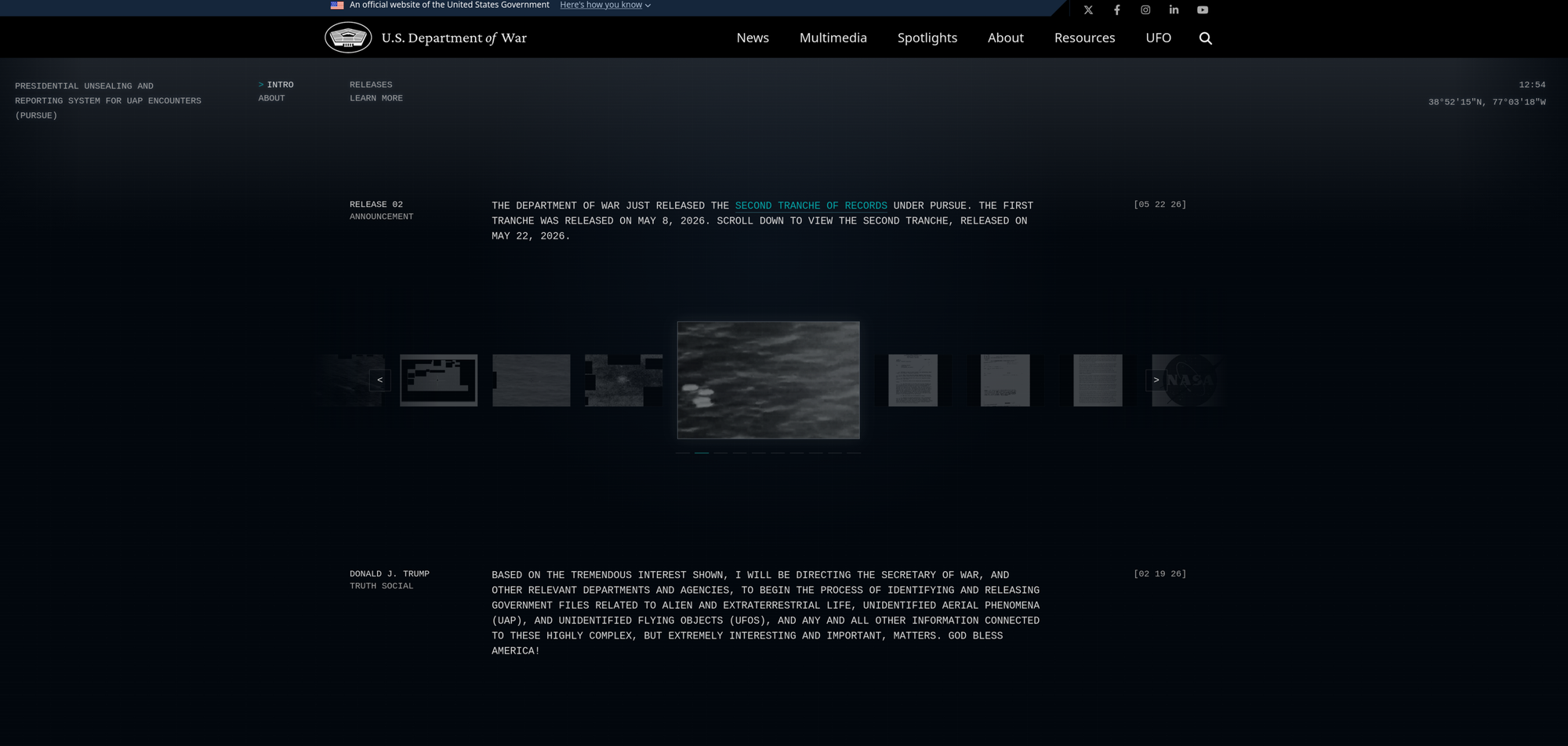
On May 8, 2026, the Department of War released 162 declassified UAP documents through PURSUE, the Presidential Unsealing and Reporting System for UAP Encounters, following a February 2026 directive from President Trump. The files included State Department cables, FBI case documents, NASA mission transcripts, and military sensor footage spanning from 1944 to recent years.
The release was politically significant in a way the files themselves may not be. A presidential directive to declassify UAP records, an interagency coordination process involving ODNI, NASA, FBI, the Department of Energy, and AARO, and a public portal at war.gov/ufo represents the farthest the federal government has moved toward formal disclosure in the era Grusch's testimony opened. Secretary Pete Hegseth stated that the files had "long fuelled justified speculation." That is not the kind of language the DoD characteristically uses about UFO inquiries it considers noise.
What the 162 documents do not contain is confirmation of crash retrieval programmes, reverse engineering, or recovered non-human material. The bulk of the cases are resolved as ambiguous or mundane on available evidence. Approximately 40 percent of the pages carry heavy redactions under national security and sources-and-methods exemptions. The 46 UAP videos demanded by Representative Luna were not included in the first tranche. Further releases are planned on a rolling basis.
The filing of 162 documents describing genuinely anomalous cases, released without a press briefing and hosted on a military domain, is neither the smoking gun disclosure advocates had hoped for nor the non-event sceptics predicted. It is the federal government formally acknowledging, in the record, that it possesses documented cases it cannot explain.
Grusch began filing internal complaints in 2021. The first formal public tranche of declassified UAP records arrived in May 2026. Whatever the institutional motivation for the timing, the sequence is not coincidental.
A second tranche of Pentagon UAP files, reviewed by Stranger Times on publication day, followed shortly after. The pace of release is itself significant: two tranches in the same week suggests either a system under pressure or a disclosure process that has found some bite.
Speaking at the Space Symposium in Colorado Springs on May 5, 2026, Grusch went further than he has in any previous public appearance. Interviewed by investigative journalist Jeremy Corbell, he told the audience that UAP disclosure would reach a tipping point within 60 to 90 days, and that the real focus should be on physical materials rather than video footage. "I do see a lot of pressure to get the substantive empirical holdings that I've talked about out in the ether," he said. The phrase "substantive empirical holdings" is not casual language from a man trained in intelligence communication. If that 60-to-90-day window holds,then we should have some updates by late July 2026.
The Sceptical Case and Where It Runs Into Difficulty
The main challenge which sceptics level to Grusch is legitimate, that his most explosive claims rest on what others have told him rather than on direct access, and no piece of physical evidence or verifiable documentation has been placed in public view. NASA's independent UAP study team noted that without data or material evidence, the claims cannot be evaluated. The Pentagon and AARO have stated repeatedly that they have found no empirical evidence of crash retrieval or reverse-engineering programmes.
On face value this objection has to be taken seriously,the more pointed question is; to what depths of cognitive dissonence do we have to sink, before we can readily accept what officialdom is asking us to believe?.
The coincidence version of events demands a tolerance for coincidences that stretches credulity,consider this. A senior intelligence officer files a UAP disclosure and loses his clearances for unrelated reasons; witnesses with programme knowledge are intimidated through ordinary bureaucratic friction; FOIA requests for specific programme names return clean results by procedural accident. One of those is possible. All three, running concurrently across years, alongside the unexplianed deaths over the years of multiple researchers and defence contractors with UAP connections, is a different proposition entirely.
The question is not whether suppression occurred. the architecture Grusch described, compartmented operations routed through private contractors, single-point information gatekeepers, and classification structures specifically designed to defeat congressional oversight, is all there. In fact, this is the operational blueprint that produced MK-Ultra.
MK-Ultra was a covert CIA programme conducted during the Cold War which explored mind control, behavioural manipulation and interrogation techniques, often through unethical experiments involving drugs, hypnosis and psychological conditioning. It officially ran for for twenty years before a Senate committee forced partial disclosure in 1975. The same institutional logic that enabled Operation Paperclip, under which former Nazi scientists and intelligence officers were absorbed into the American national security apparatus between the late 1940s and early 1960s, also allowed their records to be sanitised by some of the very agencies now alleged to be overseeing UAP programmes. By that stage, the CIA was not a neutral bureaucracy occasionally making poor decisions. It had already demonstrated a systematic capacity to run long-term covert operations beyond meaningful democratic oversight, and to employ violence when it considered violence necessary.
The people who built the classification infrastructure that Grusch spent four years trying to penetrate were, in several cases, the same people, or the direct inheritors of the people, who ran those earlier programmes. Although this does not prove his claims. It does mean that coincidence is the least supported explanation available, not the most cautious one.
What the disclosure process has so far declined to answer is not whether a suppression architecture exists, but who has been running it, for how long, and under what authority. Several UAP researchers have died in circumstances that attracted no official inquiry. That sits alongside the contractor disappearances Stranger Times has tracked, and alongside Grusch's own statement to Congress that people had been harmed in efforts to conceal what he was describing. He was not speaking abstractly.
Final Thoughts
The measure of Grusch's significance is not whether his ultimate claims are true. It is what changed as a result of him making them.
Before June 2023, the UAP question was managed through public dismissal and institutional opacity. After his testimony, it became a formal dispute between the legislative and executive branches about what exists, where records are held, and who has the authority to see them. The UAP Disclosure Act was introduced, AARO's historical record mandate was expanded and Congressional UAP caucuses were formed on a bipartisan basis. In February 2026 a sitting president issued a declassification directive and By May 2026 a dedicated federal UAP portal was live.
What Grusch has exposed is not simply an alleged cover-up. He has exposed the mechanism by which such cover-ups operate: unacknowledged SAPs routed through contractor structures, single-point information gatekeepers, and witness intimidation backed by clearance revocation. That description remains on the congressional record regardless of what is eventually uncovered, inside the programmes it describes.
There is a hypothesis that the disclosure community has long circled, but not always articulated. The reason UAP secrecy has been maintained with such ferocity, across multiple administrations, via a system willing to destroy careers and, allegedly, lives, may have less to do with the craft themselves than with everything that came with them. If reverse-engineered propulsion technology has been in private hands for decades, the implications reach well beyond aerospace. Suppressed energy technology alone, the kind that would render fossil fuels obsolete, represents an economic interest measured in the tens of trillions of dollars and a political order built on control of that resource. The shape of the oil industry, the petrodollar, the foreign policy architecture of the last eighty years: all of it becomes a different story if the technology to replace it has been sitting in a contractor facility since the 1950s. Full disclosure would not just embarrass the agencies involved. It would implicate the economic foundations on which the post-war world was built, and the crimes committed to protect them.
As a hypothesis, it may be the only one to fully explain why the suppression of UAP has been so total, so durable, and so willing to destroy the lives of people who got too close. The dam cracked in July 2023. What raging torrents of previously hidden information are waiting to burst forth when the dam finally breaks, is anyone's guess, but Stranger Times News will be here, holding the popcorn.

You might also like