
- What is documented: The Manhattan Project created a large wartime secrecy system, and the Atomic Energy Act preserved extraordinary controls around nuclear information after 1945.
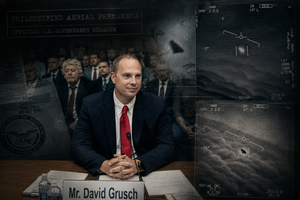
- What is claimed: David Grusch and other UAP whistleblowers argue that alleged retrieval and reverse-engineering programmes were later hidden inside similar restricted channels.
- What remains unresolved: The secrecy system is documented. The contents of the alleged UAP compartments remain contested.
The Security Clearance That Never Ended
In 1942, tens of thousands of people began work on a secret weapons programme scattered across isolated American facilities, many of whose employees were never told what they were building. At Oak Ridge, workers monitored gauges connected to processes they did not understand. At Hanford, technicians refined material whose final purpose remained concealed behind layered clearances and military supervision. At Los Alamos, entire research divisions operated within strict internal compartments, where access depended not merely on rank but on need to know. Scientists who could solve the equations governing nuclear fission were often denied information about parallel areas of the same project.
The Manhattan Project introduced something the American state had never previously attempted at that scale: industrialised secrecy.
The project did not merely hide information from foreign governments. It hid information internally, fragmenting knowledge into compartments so tightly controlled that even senior personnel struggled to understand the wider system around them. General Leslie Groves described the principle directly during later testimony: information was to be distributed only to those with a clear operational requirement to possess it. The phrase “need to know,” which later became routine throughout intelligence culture, hardened into doctrine during the early atomic era.
“Manhattan Project, they were kind of the first Blue Book.”
David Grusch, American Alchemy interview transcript, approximately 22:56 to 23:19
This statement by Grusch is not proof of recovered craft, non-human occupants or private aerospace custody of exotic materials, instead it points to a question about the veil of secrecy which lies at the heart of the UAP story; whether the legal and bureaucratic methods created to secure secrecy over atomic weapons research, was later applied to any subject the state regarded as dangerous enough to remove from ordinary review.
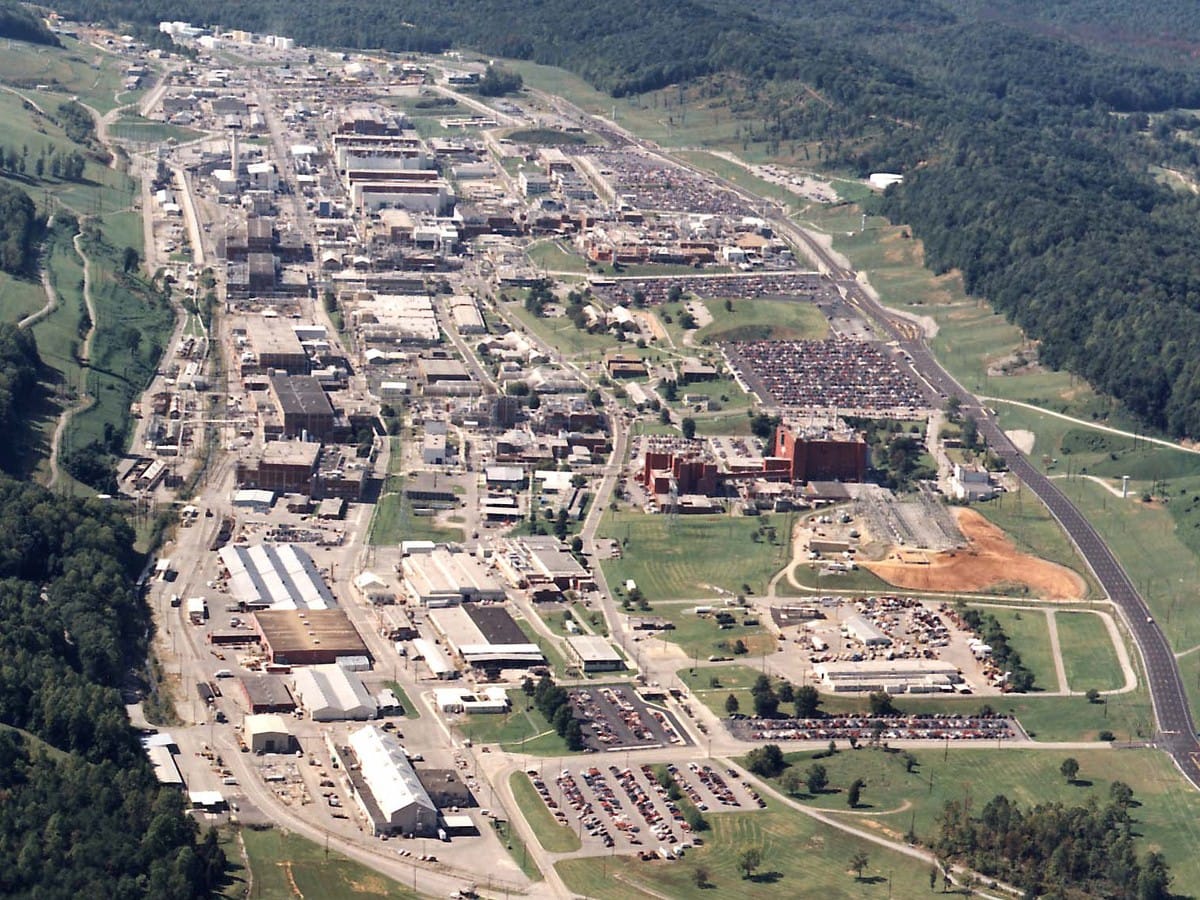
The Manhatten Project was not treated as a temporary military programme which could later return to normal democratic oversight. Instead, secrecy itself as the default position became permanent. The legal, bureaucratic and psychological systems built to protect atomic research spread steadily outward through the emerging Cold War state, attaching themselves to intelligence operations, aerospace development, signals interception, covert experimentation and, according to several modern whistleblowers, highly compartmentalised UAP programmes.
When Grusch argued in later interviews that alleged retrieval projects evolved inside systems originally built during the atomic era, see David Grusch and the architecture of UFO suppression, he was describing an underlying process of supression which is historically documented. We know they hide stuff from us, the question is, how much of this secrecy is because of a genuine need to protect national security? How much is just an automatic knee jerk procedural response to classify for the sake of it? and how much represents a conscious effort to deny humanity the truth about the existence of non human intelligence (NHI) or advanced technology which has the potential to transform humankind - in terms of energy and travel?
Atomic Secrecy and the Birth of Compartmentalisation
Before the Second World War, American military secrecy doctrine remained comparatively low key. Classified material existed, although the federal government lacked anything approaching the sprawling security bureaucracy which later defined the Cold War. The Manhattan Project changed that balance fundementally because atomic weapons introduced a category of information considered too dangerous for normal administrative handling.
The scale of the undertaking forced the government to solve problems it had never previously confronted. Entire cities had to be constructed in isolation, scientific collaboration had to coexist with rigid censorship and foreign espionage threats had to be monitored across laboratories containing some of the most important physicists on earth; many of whom maintained international academic relationships predating the war.
The solution was compartmentalisation.
Workers knew their immediate tasks while remaining blind to the larger plan. Security clearances became layered, internal surveillance increased, mail was monitored, telephone calls were restricted and personal associations attracted scrutiny. The culture surrounding the programme encouraged silence, even after the war ended, this was partly because many participants understood that they had moved seamlesly from one hot war, into a cold war of permanent geopolitical emergency.
Richard Rhodes, writing in The Making of the Atomic Bomb, described Los Alamos as a place where secrecy acquired an almost theological quality, with ordinary academic assumptions replaced by military discipline and psychological isolation. The laboratory operated less like a university than a closed state within a state.
Intelligence agencies would follow the same pattern. The Central Intelligence Agency adopted strict compartmentalisation for covert operations. Signals intelligence programmes within the National Security Agency developed additional internal partitions. Reconnaissance projects such as the U-2 and A-12 Oxcart programmes operated under extraordinary secrecy throughout the 1950s and 1960s, often concealed even from elected officials outside tightly controlled oversight circles.
This continuity becomes evident when seen in context, the Manhattan Project normalised the idea that an unelected technical elite could operate behind extreme secrecy during periods of perceived existential danger, and the Cold War removed any clear endpoint from that logic.Arguably this is a state of affairs we still inhabit today.
The Atomic Energy Act and the Legal Machinery of Silence
In 1946, Congress passed the Atomic Energy Act, legislation which placed nuclear research under civilian authority while preserving extraordinary secrecy powers around atomic information. The later amended text is available through GovInfo, which makes it a firmer reference point than secondary summaries.
The law introduced the category of Restricted Data, under which information concerning nuclear weapons design, production and use became automatically classified from the moment of creation, regardless of whether a formal classification decision had been made. This represented a major shift in American secrecy law because it treated certain knowledge itself as inherently secret.
The implications extended far beyond nuclear physics.
Restricted Data created a precedent for highly insulated information systems operating through special legal authorities separate from ordinary classification rules. Later Special Access Programmes developed similar forms of isolation, often requiring permissions beyond conventional security clearances.
During the Cold War, secrecy increasingly migrated toward these restricted compartments, until, by the 1950s, black budget aerospace projects had already begun operating through arrangements which concealed funding origins, programme existence and technical objectives from broad public visibility. Congressional oversight existed in theory, although access remained confined to small groups operating under classified conditions. Even presidents occasionally complained about informational fragmentation inside their own administrations.
President Harry Truman privately warned that the emerging intelligence apparatus risked becoming detached from democratic accountability. President Dwight Eisenhower later described the rise of the military-industrial complex with visible unease, particularly regarding the growing alliance between defence contractors, classified research and permanent military preparedness.
Those warnings are often quoted abstractly, but the machinery itself was solid and opaque as concrete. The Atomic Energy Commission controlled enormous classified programmes while The CIA expanded covert operations globally. Defence contractors absorbed advanced research under classified procurement systems and Intelligence agencies developed secure facilities shielded from conventional scrutiny. The United States had in effect entred into a state of continuous military mobilisation, which required continuous secrecy.
UFO researchers who argue that retrieval programmes could remain hidden for decades inside this environment are therefore making two separate claims, one speculative and one historical. The speculative claim concerns the existence of the programmes themselves. The historical claim concerns the existence of the secrecy infrastructure capable of concealing them.
Blue Book and the Public Face of UFO Control
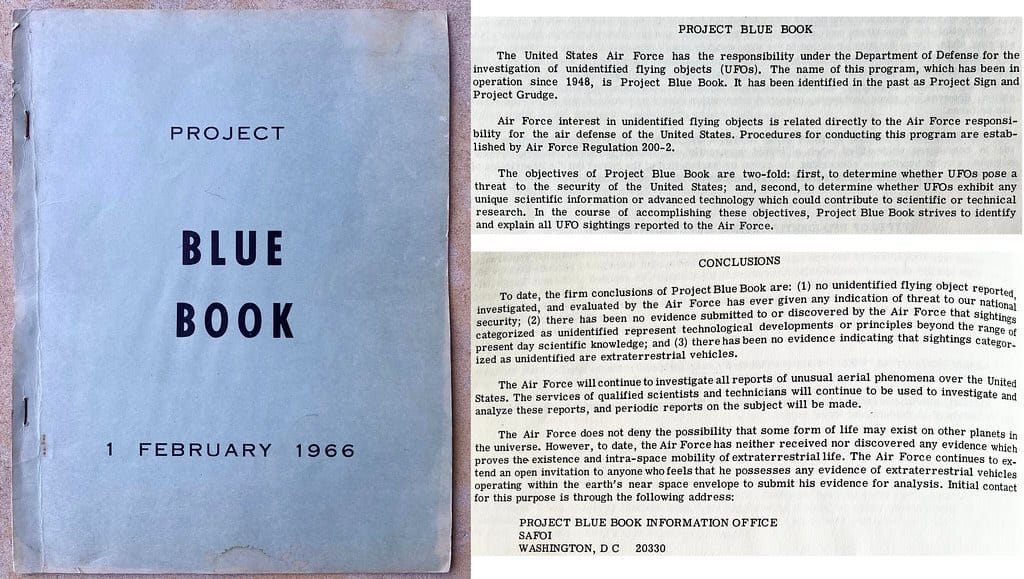
Project Blue Book was the official Air Force investigation into UFO reports between 1952 and 1969. The National Archives states that the records are declassified and available for examination, and the Air Force position after the project closed was that no sighting classified as unidentified had shown evidence of extraterrestrial vehicles.
That conclusion remains one of the most disputed in the history of the UFO subject. While Blue Book was presented as an objective scientific investigation, critics argued that its primary function increasingly became the management of public perception rather than the pursuit of difficult answers. The project's legacy became inseparable from a series of explanations that many witnesses regarded as implausible or dismissive, including the notorious "swamp gas" explanation offered for the 1966 Michigan sightings and the repeated attribution of unexplained aerial objects to the planet Venus. To supporters of the cover-up hypothesis, these cases became emblematic of a system more concerned with reducing public interest than resolving genuine anomalies.
The debate intensified following the publication of the 1968 Condon Report, which concluded that further study of UFOs was unlikely to yield significant scientific advances. That finding provided the justification for closing Blue Book the following year. Critics, however, noted that a number of unexplained cases remained within the files and argued that the report's conclusions appeared more definitive than the evidence warranted. Even Blue Book consultant J. Allen Hynek would later distance himself from the programme's public posture, arguing that many reports had been prematurely dismissed and that the phenomenon deserved more rigorous scientific study.
That public finding did not end the problem. Blue Book became both archive and symbol: an official record of thousands of reports, and a reminder that the state had treated the subject seriously enough to collect, categorise and investigate it under military authority. For many researchers, it also became a case study in how official institutions can shape public understanding of a phenomenon without necessarily resolving the underlying mystery.
The CIA’s Robertson Panel in 1953 gave the official concern a sharper edge. Its report did not frame UFOs as proven alien craft. It warned instead that mass reporting and public excitement could overload communication channels and create exploitable confusion during crisis. The recommendation was not disclosure but control, including public education designed to reduce interest.
“The phenomenon reported is something real and not visionary or fictitious.”
Lieutenant General Nathan F. Twining, “AMC Opinion Concerning Flying Discs,” 23 September 1947
The state did not need to believe UFOs were extraterrestrial to treat them as a national security problem. Reports could be misidentifications, secret aircraft, Soviet probes, psychological contagion or unknown intrusions. In a Cold War warning system, all of those possibilities created work for intelligence officers.
One interpretation treated sightings as noise to be reduced. Another treated them as signal to be monitored. The public saw Blue Book. The harder question is whether any deeper channel carried the reports that Blue Book could not resolve.
Paperclip, MKUltra and the Classified State
Operation Paperclip and MKUltra belong in this file because both show what Cold War secrecy allowed officials to justify once national security became the governing argument.
Paperclip brought predominatly ex-Nazi German scientists and specialists into American service after the war, including figures whose pasts were sanitised to make them useful to the new strategic order. MKUltra showed how unfettered oversight could lead to government agencies making increasingly unethical decisions, with CIA-backed behavioural and drug experiments conducted through front organisations, universities and hospitals, often without informed consent.
Neither programme proves a hidden UFO retrieval project, but they do prove that American agencies could operate large projects in secrecy for years, deny or fragment the record, and leave later investigators to reconstruct the truth from damaged files, partial admissions and congressional inquiries. This background should affect how modern UAP claims around crash retrevals or back engineering of NHI techology are received. The claim that the government could never run a concealed programme of that scale does not survive even the most basic scrutiny, that these claims of hidden UAP knowledge have proven to be so enduring, despite the secret state's best efforts to disinform, suggesst at the very least there may be some fire with all that smoke.
The Contractor Wall
Modern defence secrecy does not sit only inside government buildings. It runs through private aerospace firms, restricted laboratories, subcontractors and compartmented engineering teams whose work may remain invisible even to cleared officials outside the relevant access channel.
Grusch has suggested that private contractors may have held material or conducted research linked to legacy retrieval programmes. Public evidence proving that claim has not been produced, partly because such private programmes exist beyond the Jurisdiction of FOIA or public governance. The surrounding method, however, resembles known classified procurement practice.
Black aircraft programmes offer the conventional comparison. The U-2, A-12 and F-117 all generated sightings before their public acknowledgement. Area 51 was widely discussed before the government formally admitted its role. Secrecy produced folklore because the aircraft were real and the explanations were withheld.
Nuclear Weapons and Persistent Intrusions
No aspect of the UFO record intersects more consistently with national security infrastructure than nuclear weapons. From Los Alamos and Sandia to Malmstrom, Minot, Loring, Vandenberg and Faslane, reports involving anomalous aerial activity repeatedly cluster around atomic facilities and strategic delivery systems.
Robert Hastings spent decades collecting testimony from military personnel who claimed objects interfered with missile systems, hovered above restricted installations or appeared during periods of nuclear readiness. Former launch officer Robert Salas described one of the most widely cited incidents at Malmstrom Air Force Base in March 1967, during which several missiles reportedly became inoperative while security personnel observed unusual aerial activity outside the facility.
The Air Force disputes portions of the account. Researchers continue arguing about equipment reliability, witness memory and contradictory records. Yet the pattern extends beyond any single case.
British nuclear facilities produced comparable reports. Soviet military archives contain similar allegations. Declassified American documents show that intelligence agencies continued monitoring UFO reports around strategic sites long after official public investigations claimed the subject held little defence significance. See also Stranger Times News's existing UAP and nuclear weapons archive, where the same pattern is already being built into a wider case file trail.
The pattern adopted the technology of its era just as earlier anomalous traditions reflected theirs; the underlying uncertainty remained.
Grusch and the Continuity Argument
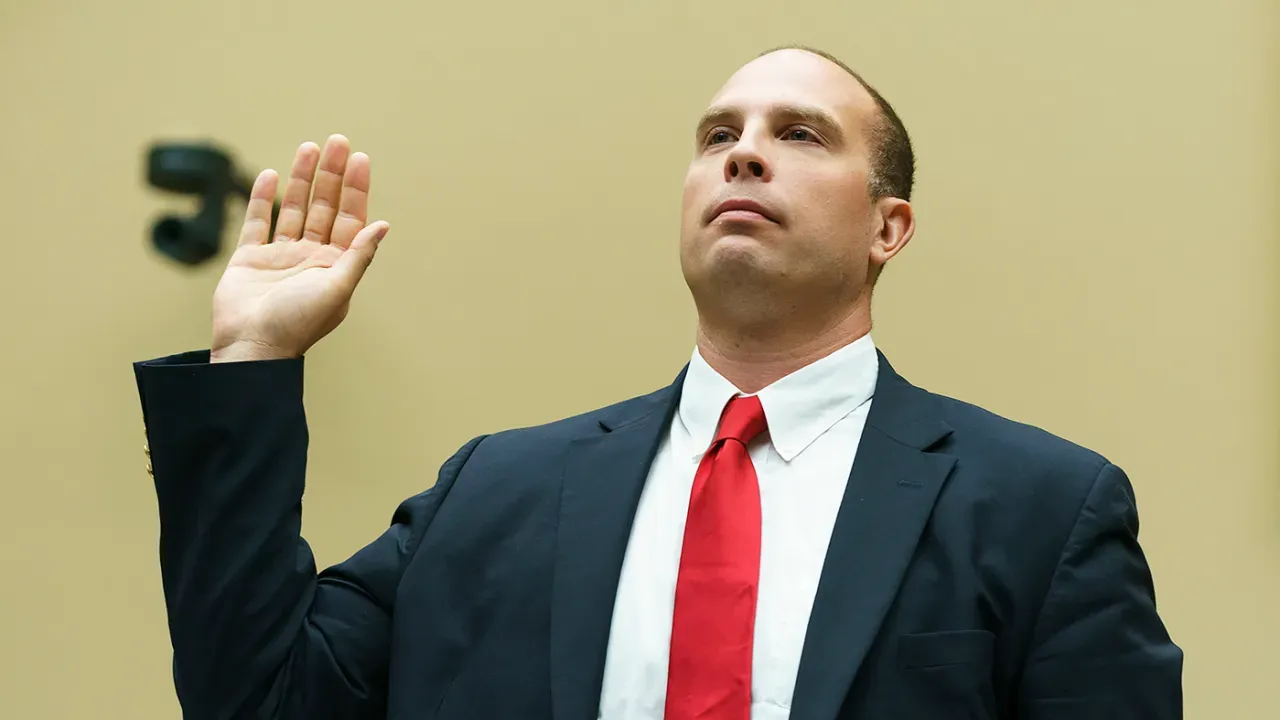
Grusch’s allegations landed differently from earlier UFO claims because he spoke in the language of procedure. He referred to inspectors general, programme access, reprisals, congressional notification and legacy compartments rather than only to lights in the sky. That does not make the underlying claims true but it does make them harder to place in the usual category of unsupported UFO folklore.
In a recent interview on the American Alchemy podcast, Grusch returned to the idea that the UFO problem had been folded into systems created around atomic secrecy. He also suggested that the Atomic Energy Act could provide a route for treating recovered material as protected if it emitted radiation or involved exotic energy characteristics.
“If something is not a nuke, but it has radiological energy coming off it, you know, alpha, beta decay, whatever. Same secrecy.”
David Grusch, American Alchemy interview transcript, approximately 21:44 to 22:05
The UAP Disclosure Act language introduced by Senators Chuck Schumer and Mike Rounds sharpened the political problem because it referred to UAP records, technologies of unknown origin and legacy programmes in language far more specific than earlier congressional gestures. The final legislative outcome did not settle the issue, but the attempt showed that senior lawmakers were willing to legislate as though hidden records and material custody were plausible enough to require statutory handling.
This is where the file remains open. If Grusch is wrong, the episode still exposes deep mistrust between Congress, defence agencies and the classified aerospace world. If he is right, the Manhattan Project did not only create the bomb, It created an infrastructure of intense secrecy which has never been reigned in, long after its original purpose ceased to exist.
Final Thoughts
The Manhattan Project did more than build the atomic bomb.It established a permanent model for secrecy.
The project demonstrated that enormous classified systems could operate beyond ordinary public visibility for long periods under conditions of perceived existential threat. It normalised compartmentalisation, restricted oversight, contractor shielding and permanent secrecy culture inside the American national security system.
The Cold War expanded that machinery dramatically.
Reconnaissance programmes disappeared behind black budgets. Intelligence operations fragmented into isolated compartments, covert experiments proceeded without public awareness and advanced aerospace projects remained hidden for decades.
This history does not prove that hidden UAP retrieval programmes exist, but it does establish that the environment described by modern whistleblowers is historically plausible because much of the surrounding secrecy apparatus already operates in documented form.
Sceptics are correct that claims alone are not evidence. Stories grow in the telling. Rumours spread. Myths acquire details they never possessed at the start. The UFO subject contains more than its fair share of all three.
Yet history leaves behind another uncomfortable fact. Intelligence agencies, military organisations and governments have repeatedly concealed programmes that citizens were told did not exist. Some remained hidden for years. Others for decades. That does not mean every extraordinary claim is true. It means the question cannot be settled by ridicule alone. Somewhere between credulity and dismissal sits a body of evidence that has refused to disappear for more than seventy years.
What remains unresolved is whether the same secrecy apparatus eventually concealed something far stranger.