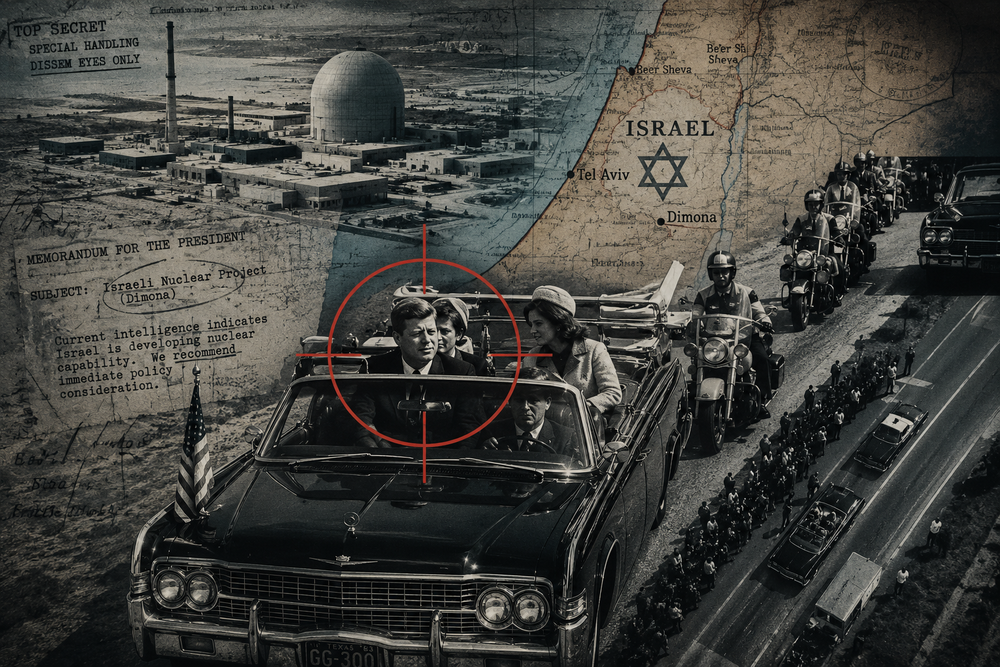
On 21 November 1963, The New York Times carried a headline reporting that Israel was furious with the Kennedy administration over a proposed United Nations resolution concerning Palestinian refugees. Twenty-four hours later, John F. Kennedy was dead in Dallas.
This alone proves nothing, and history is riddled with coincidences later pressed into conspiratorial service. Yet the revived argument around Kennedy's relationship with Israel. his sceptism over the Israeli Dimona nuclear programme and the undeclared intelligence connections between the C.I.A and Mossad rests on more than just timing. It rests on declassified correspondence and the uncomfortable fact that Kennedy’s relationship with Israel in the early 1960s looked very different to the alliance that later emerged.
At the centre of the dispute sits a question which has circulated among Kennedy researchers for decades: how far was the Kennedy administration prepared to go in preventing Israel from obtaining nuclear weapons?
Kennedy and the Dimona Dispute
By the early 1960s, American intelligence already suspected that Israel’s Dimona facility in the Negev desert was more than just a civilian research installation and had a dual purpose to help develop an Israeli nuclear bomb.French assistance, restricted access and evasive diplomatic exchanges had already caused concern within Washington, particularly for an administration still scarred by the near miss of nuclear armageddon sparked by the Cuban Missile Crisis and the risks associated with nuclear proliferation.
Kennedy repeatedly pressed Israeli Prime Minister David Ben-Gurion to permit meaningful American inspections of the site and grew frustrated as Israeli officials stalled or obfuscated these requests, before eventually agreeing to the inspections, but only within the context of carefully managed visits under tightly regulated conditions.
The historical record is clear.
Declassified correspondence between Kennedy and Ben-Gurion shows the White House pressing for regular inspection access, while Israeli officials attempted to reassure Washington, without fully disclosing the Dimona programme’s military purpose. Historians still disagree over how much Kennedy understood about Israel’s progress toward manufacturing an atomic bomb but few serious researchers now argue that the administration was blind to the possibility.
Kennedy’s concern was not limited to Israel however, he was trying to contain the spread of nuclear armed nations that existed across the world. Kennedy believed that a nuclear armed Israel risked driving Arab states closer to the Soviet Union, damaging American influence across the Middle East in the process, which could ultimately force Washington into regional alignments by default, rather than design. This was something Kennedy was keen to avoid.
Although the difference between the U.S.A's initial position of measured scepticsm and it's later policy of unwavering and total support for Israel is stark, few modern commentators seem to address it. Kennedy was not treating Israel as an untouchable ally, He saw Israel as a state whose actions could damage American interests.
The AIPAC Predecessor and the Foreign Agent Battle
Another strand in the file concerns Kennedy’s conflict with the American Zionist Council, the organisation widely regarded as the precursor to AIPAC.
Justice Department officials under Kennedy attempted to compel the organisation to register under the Foreign Agents Registration Act, placing pro-Israel lobbying, foreign funding and domestic American politics under the same legal scrutiny applied to other foreign-linked influence operations.
During the early 1960s, Attorney General Robert Kennedy’s Justice Department pressured the American Zionist Council over activity linked to Israeli interests. The dispute faded after Kennedy’s assassination, and the organisation later developed into AIPAC, which became one of the most powerful lobbying forces in Washington.
Whether this conflict was a legal dispute or part of a wider geopolitical clash remains contested and critics of the broader theory argue that attempts to connect these events directly to the assassination stretch credulity. While these files do not establish a cause, they do demonstrate that there was a fair amount of friction between Kennedy's administration and the Israeli government at this time.
James Jesus Angleton and the Israeli Channel
Where the idea of more involved Israeli collaboration in the the affairs of the U.S secret state develops, concerns the relationship of Israeli security agencies with one James Jesus Angleton, the CIA counterintelligence chief whose career became tied to secrecy, paranoia and unofficial relationships.Angleton helped shape early CIA-Israeli intelligence cooperation and maintained direct access to Israeli operatives throughout his carreer
Angleton's close ties to Israeli intelligence have long been documented, and Israeli officials praised him openly after his death.
Recently unredacted material has generated renewed interest in the degree of freedom Angleton enjoyed in his work. The claim now circulating is that multiple CIA directors permitted him to run intelligence projects with Israeli intelligence services outside of normal reporting channels. If accurate,this would give the Dimona dispute a darker more conspiratorial dimension: while Kennedy pressed Israel over nuclear inspections, a senior CIA officer with unorthodox ties to Israel was operating through a channel that sat outside of the usual oversight.
What remains uncertain is how far those relationships extended into nuclear assistance.Researchers have pointed for years to the NUMEC affair.
The NUMEC affair was a 1960s scandal involving the disappearance of hundreds of pounds of highly enriched uranium (HEU) from the Nuclear Materials and Equipment Corporation (NUMEC) plant in Apollo, Pennsylvania. Investigations by the FBI and CIA strongly suspected the missing nuclear material was diverted to support Israel's nuclear weapons program, perhaps with collusion from Angleton.
Former CIA officer Victor Marchetti later claimed that Angleton obstructed investigations into Israeli nuclear activities and protected Israeli interests inside the Agency. Seymour Hersh also connected Angleton to the wider Israeli nuclear file in The Samson Option, arguing that he acted as a trusted back-channel between Mossad and sections of the CIA.
The strongest documented link comes through Angleton’s relationship with Zalman Shapiro, NUMEC’s founder, and the repeated visits to the NUMEC facility by Israeli intelligence and scientific figures during the mid-1960s. Those visits attracted FBI and CIA attention later because they coincided with the missing uranium problem.
No definitive public evidence has ever surfaced to support the claims, although suspicion has persisted for decades within the American intelligence community circles that this was indeed the case
The renewed JFK file discussions have revived those older suspicions because they place Angleton inside the same frame as Kennedy’s campaign against Dimona. while Angleton's connections are real, whether his activities implies something darker is another question entirely.
Dallas, the Israeli Delegation and the Problem of Coincidence
The most contested claim concerns an Israeli military delegation which was visiting the United States in November 1963. The allegation suggests that senior Israeli military figures were in Dallas on the day Kennedy was assassinated and left the country shortly afterwards.
The presence of Israeli officials in the United States during that period is reflected in diplomatic and military records tied to Hawk missile negotiations between Washington and Tel Aviv. Kennedy approved the sale at the same time his administration was demanding greater access to Dimona, leaving the relationship caught between strategic cooperation and growing mistrust.
Researchers drawn toward conspiracy have treated the delegation’s proximity to Dallas as inherently suspicious. Critics counter that foreign military officials, intelligence officers and diplomatic envoys moved constantly through American defence circles during the Cold War, which makes presence alone a weak foundation for larger claims.
Even so, the image of Israeli foreign nationals abruptly leaving the United States after a national trauma carries an uncomfortable historical echo.
After 9/11, five Israeli men employed by a moving company were detained after witnesses reported seeing them filming the burning towers from New Jersey while appearing to celebrate. According to police reports and later media investigations, one witness described them as looking as though they were “happy” or “high-fiving” beside their van as smoke poured from Lower Manhattan.
The episode became known as the “dancing Israelis” case and quickly slipped into the unstable territory where counterterror investigations, intelligence operations and conspiracy culture overlap. The five men detained after the attacks were not random tourists. Several had prior Israeli military service, and FBI investigators explored possible intelligence links before the group was eventually deported to Israel on immigration violations.
The continued withholding of classified material relating to the Kennady assasination keeps the suspicions surrounding his death in the public eye. Former CIA officer John Kiriakou has claimed that thousands of JFK-related files connected to Israel remain withheld from public release. That claim cannot be fully tested while the records themselves remain inaccessible, which is the neat trick secrecy always performs: institutions accused of concealment become the same institutions responsible for deciding what the public is permitted to see.
Final Thoughts
More than six decades after Dealey Plaza, the Kennedy assassination remains buried beneath competing theories, intelligence rumours and partial disclosures.
The dispute over Israel’s Dimona nuclear programme is documented, Kennedy pressured Israel over inspections, moved against the American Zionist Council under foreign-agent laws, and James Jesus Angleton maintained unusually close ties with Israeli intelligence.
It must be stated that no direct evidence links those conflicts to Kennedy’s assassination. Critics see this absence as decisive, but Others argue that intelligence operations involving allied states would leave exactly this kind of fragmented record behind them.
Because large parts of the JFK files remain sealed or redacted The question persists. After sixty-three years, if there is nothing to hide, why all the secrecyq?
Sources: This report draws on the Katie Halper interview with Wally Rashid and Ken McCarthy, available on YouTube, and Maximilian’s article, What the Archive Knows: JFK, Dimona, and the Spy Who Served Two Masters.