
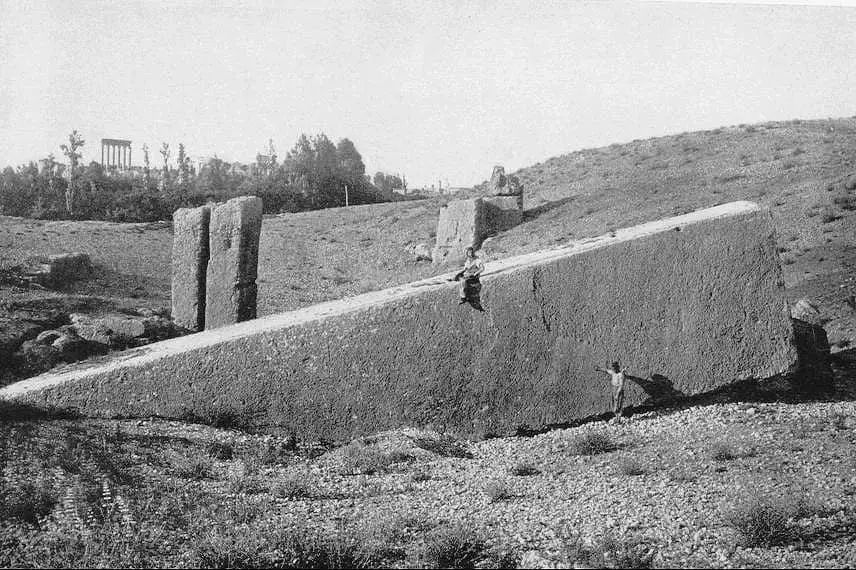
The ancient ruins of Baalbek in modern-day Lebanon remain one of the most extraordinary and controversial engineering sites in the ancient world. Best known for the colossal stone blocks embedded within the foundations of the Temple of Jupiter, the site has long occupied the uneasy territory between established archaeology, speculative history and Fortean fascination.
At the centre of the mystery are several gigantic limestone monoliths, some weighing between 800 and 1,650 tons. The most famous of these form part of the temple platform known as the Trilithon, three immense stones positioned with astonishing precision high within the retaining wall of the Roman-era complex. Nearby, in an ancient quarry slightly uphill from the temple, lie even larger unfinished blocks including the so-called “Stone of the Pregnant Woman” and the “Forgotten Stone”, the latter estimated at around 1,650 tons and believed to be among the largest stone blocks ever quarried in antiquity.
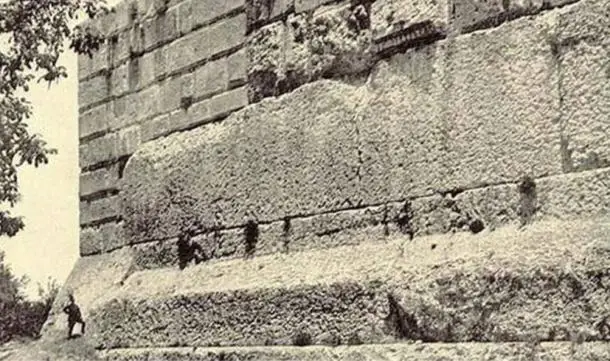
Mainstream archaeology attributes the Baalbek complex largely to Roman engineering during the early Imperial period, with the Temple of Jupiter constructed atop an older sacred site associated with the ancient Phoenician god Baal. Researchers point out that the quarry sits slightly above the temple complex, meaning the stones may have been transported downhill using rollers, earthen ramps, ropes and coordinated labour rather than lifted vertically in the modern sense.
Yet despite those explanations, Baalbek continues to provoke debate because of the sheer scale involved.
Even modern engineers studying the site acknowledge the extraordinary logistical challenges posed by quarrying, transporting and positioning stones of such immense size with ancient technology. The precision of the stone placement, combined with the absence of surviving construction records explicitly describing the methods used, has fuelled centuries of speculation.
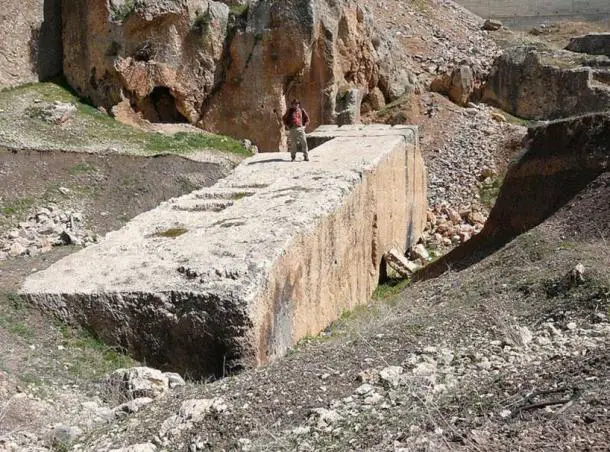
Alternative historians and ancient civilisation theorists have frequently argued that Baalbek may preserve evidence of lost engineering knowledge or a far older construction phase later incorporated into the Roman temple complex. Some point to the unusual gigantism of the foundation stones, noting that comparable blocks are rarely seen elsewhere in Roman architecture. Others argue that the Romans may have inherited and expanded upon an earlier megalithic platform whose original builders remain unknown.
Ancient astronaut proponents have pushed the theory further still, suggesting the site reflects the involvement of advanced non-human intelligence or forgotten technologies. Those claims remain unsupported by archaeological evidence, but the mystery surrounding the unfinished monoliths has ensured Baalbek remains a recurring subject within Fortean literature and fringe historical research.
Part of the fascination stems from the unsettling contradiction at the heart of the site itself. The stones undeniably exist. Their dimensions are measurable. Their weight is not speculative fantasy but established engineering reality. The unresolved question is not whether they were moved, but how ancient builders achieved it with the tools and materials available to them at the time.
Online discussions surrounding Baalbek reveal a continuing divide between sceptics and alternative theorists. Some argue that leverage, ramps, rollers and mass labour are entirely sufficient explanations and that modern observers underestimate ancient ingenuity. Others counter that scaling known Roman techniques up to stones weighing well over 1,000 tons remains an engineering challenge difficult to fully reconstruct even today.
The site’s broader history only deepens its aura. Baalbek sits atop a settlement with evidence of habitation stretching back thousands of years before the Roman temple complex itself. Archaeological excavations have revealed layers of occupation extending into prehistory, suggesting the location possessed religious or ceremonial importance long before the arrival of Imperial Rome.
For mainstream archaeology, Baalbek ultimately stands as a testament to the capabilities of ancient engineers operating at the limits of organised human labour and ambition. For Fortean researchers, however, the site remains something more elusive: one of several ancient locations where the surviving physical evidence seems almost disproportionate to the historical explanations surrounding it.
More than two thousand years after the great stones were cut, abandoned and assembled, Baalbek continues to provoke the same uneasy question that has followed it since antiquity: not merely why such immense blocks were used, but why anyone felt the need to build on such a scale in the first place.