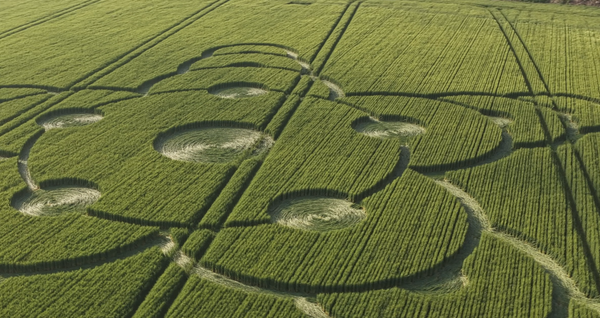
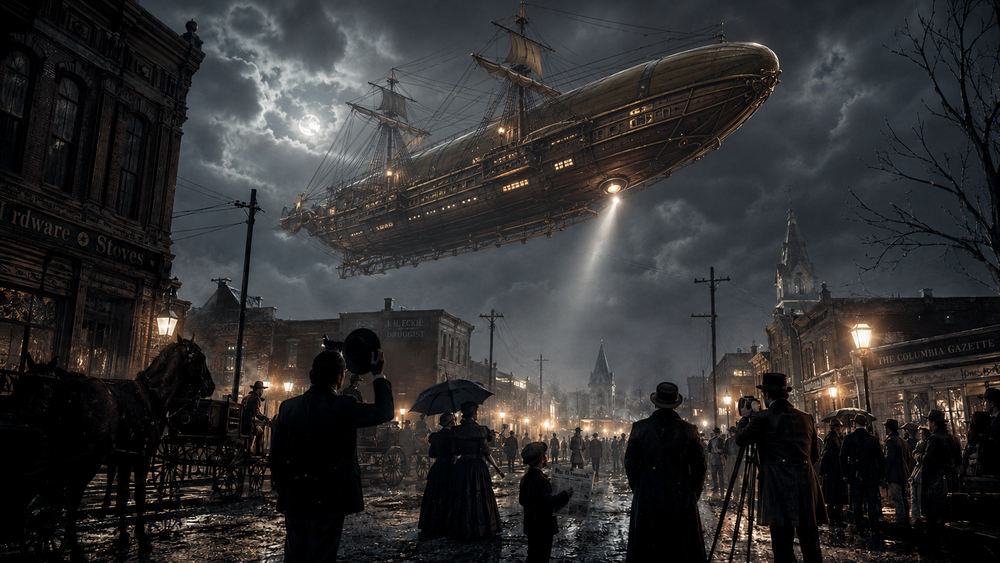
In the closing weeks of 2024, thousands of witnesses across New Jersey, New York and neighbouring states reported large, silent objects moving nightly over military installations, nuclear facilities and civilian infrastructure. Four federal agencies reviewed over five thousand sightings and found nothing anomalous. No operators were identified. No craft were recovered. The objects, if that is what they were, vanished from the official record in exactly the way unidentified aerial phenomena always vanish from the official record: attributed to misidentification, dismissed as mass panic, and filed away.
This has happened before. Not once, but repeatedly, and the first time it took place was not in the Cold War or the postwar flying saucer era, but in the gaslit winter of 1896.
The phantom airship wave of 1896–97 is often dismissed as a curious prelude to the modern UFO era, a strange Victorian fad that belongs more to folklore than serious anomaly research. Yet the closer the reports are examined, the harder it becomes to treat them as an isolated historical episode. The same broad pattern reappears across later UAP waves, extending through the twentieth century and into the drone incursions of 2024. What changes is the imagery each era places around the phenomenon. The underlying problem, structured aerial objects, credible witnesses, official concern and explanations that collapse under scrutiny, remains strikingly familiar.
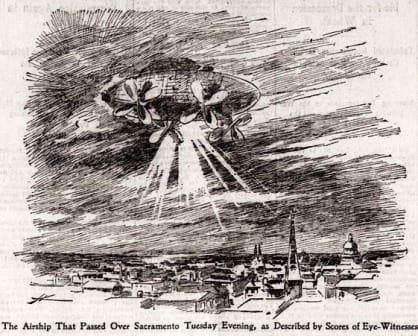
On 17 November 1896, witnesses in Sacramento reported a brilliantly illuminated aerial object moving slowly and deliberately across the evening sky at low altitude, several years before the Wright brothers left the ground at Kitty Hawk. Within weeks the reports had spread across California, and by the spring of 1897 they had moved through the American Midwest and into Texas, generating one of the most substantial bodies of anomalous aerial testimony in the historical record. What witnesses described were not vague lights on the horizon but structured machines fitted with powerful lamps, capable of directional movement against the wind, and in some cases apparently occupied by human figures who spoke, offered explanations and disappeared before daylight.
The Problem With The Newspapers
No serious examination of the airship wave can avoid the problem of the late Victorian press. The period sat at the intersection of mass literacy, industrial printing and fierce competition between regional newspapers, many of which mixed legitimate reporting with embellishment, satire and outright invention. Editors understood that technological stories sold papers, and the final years of the nineteenth century were saturated with speculation about electricity, flight and radio transmission, creating ideal conditions for rumour and genuine misperception to bleed together.
For a substantial number of reports, the sceptical case stays there. Rival editors openly accused competing papers of manufacturing details to satisfy a readership that already expected revolutionary breakthroughs, and contemporary observers described the public appetite for airship news as gluttonous.
The Reports Nobody Should Believe
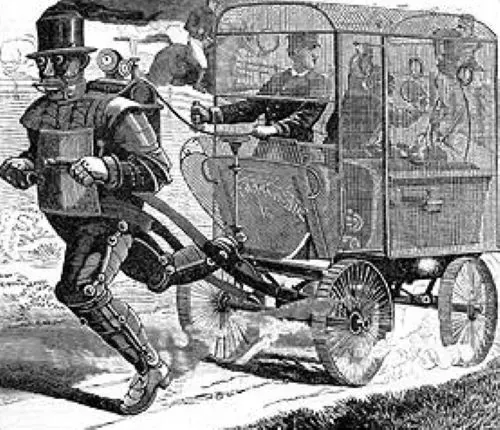
Some reports are transparently theatrical. Airship crews invite witnesses aboard for cigars. Strange inventors appear from nowhere, speak cryptically about engines no one can understand, refuse to give their names and vanish before daylight. One Texas account describes a pilot who steps from his craft to ask a farmer for a bucket of water and then takes off again without explanation. Another features the crew of once airship lowering a rope ladder to the ground, exchanging pleasantries with a rancher before departing without incident. This account reads less like a genuine encounter than a short story without a conclusion. These are the cases that the sceptical argument relies upon. A press operating without editorial restraint, competing for readers in a market saturated with technological speculation, could produce exactly this kind of material on demand.
Except that the request for water, the offered food, the small mundane exchanges before departure, are not confined to the 1897 airship reports. In A Trojan Feast (2015), researcher Joshua Cutchin documented the same motif running through fairy tradition, early UFO contact reports and modern abduction accounts: the entity asks for, or offers something, and the exchange is always slightly off, slightly transactional, slightly wrong in ways that are difficult to articulate.
European fairy lore warns explicitly against accepting food or drink from these figures, because to do so traps you in their world. Modern abductees describe being offered strange liquids or pills. The 1897 airship witnesses being asked for water by a pilot in overalls belongs to the same pattern; this does not make it true of course, but does make it harder to dismiss as pure invention by someone who wasn't familiar with European fairy lore.
The Aurora incident
The Aurora case sits awkwardly between those categories. On the morning of April 17, 1897, a cigar-shaped craft reportedly struck the windmill on the property of Judge J.S. Proctor, scattering debris across the farm. The pilot, recovered from the wreckage, was described by the Dallas Morning News as "not of this world," and the town buried him with Christian rites in Aurora Cemetery. On first examination it looks exactly like the kind of story a struggling community might manufacture: Aurora had suffered recent crop failures, a fire and the railway's decision to bypass it entirely, also S.E. Haydon, the correspondent who filed the report, had a known reputation as a prankster. The town's economic distress was real and the hoax case has genuine merit.
Investigations which have taken place over the following decades have complicated the Aurora hoax narrative considerably. MUFON investigators in the 1970s located a grave marker in Aurora Cemetery, which appeared to depict a flying saucer, and recorded anomalous metal detector readings at the burial site. They interviewed two eyewitnesses, Mary Evans and Charlie Stephens, whose accounts were independent and consistent with the 1897 report. A 2008 History Channel investigation opened the sealed well on Proctor's former property and retrieved metal fragments with anomalously high aluminium content. Ground-penetrating radar identified an unmarked grave in the relevant section of the cemetery and it looked to everyone like the mystery would be solved with a follow up investigation.
Then the grave marker mysteriously disappeared and a metal pipe was installed into the ground at the site, causing metal detector readings to fail, leading MUFON to conclude that the material had been removed. Since 2008 the town cemetery association has declined all requests for exhumation and so it looks like we will never know what, if anything crashed at Aurora and whether a non human entity was ever buried in the town cemetery. Whether Aurora was a hoax, a genuine anomalous event, or something in between, it is not an easy case for the sceptical enquirer to close.
The Reports That Don't Go Away
Cutting through the sensationalism and hubris of the American press during this period, we find that their are reports which are worthy of further investigation, these are often the most mundane, in exactly the way hoaxes usually are not. Witnesses in Sacramento for example described a structured, illuminated object moving at low altitude across the evening sky, with accounts that varied in peripheral detail but agreed on the central fact of deliberate movement. Similar reports followed in Oakland, San Francisco and across northern California in the weeks after. Newspapers attempted explanations almost immediately: a balloon carrying lanterns, astronomical confusion, collective suggestion amplified by sensational coverage. These struggled with aspects of the testimony that kept recurring across independent locations, with witnesses consistently describing directional movement, altitude changes and behaviour inconsistent with passive drift.
Nineteenth-century observers were already familiar with lights in the sky, and comets, meteors and atmospheric effects generated no particular excitement. The airship reports were disturbing for a different reason: apparent intention. In Omaha on 29 March 1897, crowds reportedly gathered to watch an illuminated object moving across the night sky before departing northwest. Across Texas, reports from Austin, Manor and surrounding communities described lights sweeping fields at low altitude. Searchlight-like beams appear in the testimony decades before such imagery became attached to the modern UAP phenomenon.Then the accounts become stranger.
Vallée's Argument: The Phenomenon Wears What Each Era Expects
Farmers claimed that craft would land in their fields or farms, and some reported conversations with the occupants. The figures described were rarely anything approaching extraterrestrials in a modern sense: inventors, mechanics, aeronauts and travellers in ordinary clothes who asked for water or basic food ingredients and explained themselves through the language of engineering and industrial progress.
In Passport to Magonia, Jacques Vallée made this detail central to his argument: the phenomenon speaks in the idiom of the culture it enters. He treated the airship wave not as a simple precursor to the flying saucer reports of the 1940s and 1950s but as evidence that anomalous encounters adapt themselves to the symbolic and technological expectations of each era.
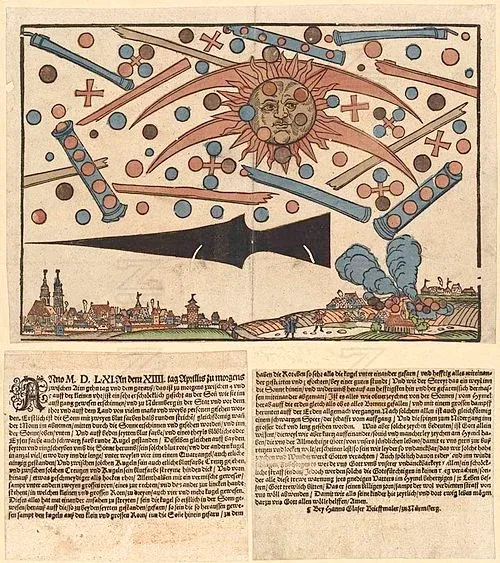
Medieval Europe reported fairy processions, aerial ships and visitors descending from hidden realms, while nineteenth-century America produced mechanical airships, years before such machines existed in practical form. By the time the Twentieth century came around, witnesses were having the same recurring experience, only this time they were reporting the imagery of metallic discs and structured craft associated with aerospace technology. Surface imagery shifts with each generation, while the underlying narrative structure remains inexplicably the same.
Vallée was not arguing that fairies and airship pilots are the same entities wearing different costumes. His argument was more disturbing than that. He proposed that the phenomenon behaves less like visitors from another planet and more like a persistent system of encounters interacting with human belief, culture and perception across centuries, adapting itself to what each period is capable of imagining without fully conforming to it. He regarded the extraterrestrial hypothesis as too narrow because it failed to account for the deep continuity between modern UAP reports and the older encounter traditions that preceded them.

Foo Fighters and Rocket Ships
During the Second World War, Allied and Axis pilots independently began reporting small, luminous objects that paced their aircraft, matched their manoeuvres and could not be engaged with or outrun. They called them foo fighters. Neither side knew the other was seeing them until after the war, which ruled out propaganda, and no government explanation has ever been produced. The objects appeared to pilots of the 1940s in exactly the right form that witnesses of that period could recognise: fast, technological and airborne, bearing no resemblance to anything from 1897.
Then came the ghost rockets. Between May and December 1946, approximately two thousand sightings of rocket- or missile-shaped objects were logged across Sweden, Finland and Norway, two hundred of which were confirmed on radar. The obvious explanation at the times was Soviet test firings of captured German V-2 technology, and the Swedish military took the hypothesis seriously enough to suppress press coverage of exact flight paths.
Swedish, British and American investigators found no recognisable rocket fragments at any of the crash sites they investigated, the objects displayed no exhaust trails and moved too slowly for ballistic missiles. Sometimes the rockets were reported to fly in formation, and in several documented cases even changed course. On 19 July 1946, a grey winged object crashed into Lake Kölmjärv, and a three-week search by the Swedish military found a disturbed lake bed and nothing else. The officer who led the search concluded the object had probably been manufactured from a lightweight magnesium alloy designed to disintegrate on impact, which is either the most extraordinary admission in post-war military history or a very cautious way of saying he had no idea what he was looking for.
In October 1946 the Swedish Defence Staff told a press conference: "In some cases, clear, unambiguous observations have been made that cannot be explained as natural phenomena, Swedish aircraft, or imagination on the part of the observer."Whatever crossed the skies above Scandinavia in 1946 adopted the imagery of the dawning rocket age, just as the mysterious airships of 1896–97 reflected the industrial imagination of their own era. Yet the underlying mystery remained strikingly similar: structured aerial objects, no known technology capable of producing them, credible witnesses, official documentation, and no explanation that survived serious scrutiny of the evidence.
A Future The World Had Not Yet Invented
The airship mystery has also attracted a simpler explanation: secret experimental aircraft developed by unknown inventors operating ahead of publicly known aviation technology. On the surface it sounds reasonable, since the late nineteenth century was full of independent engineers, patent races and technological secrecy. Samuel Langley had already demonstrated successful powered model flights by 1896, and lighter-than-air travel was an established reality.
The theory falls apart under further scrutiny however, as no convincing evidence for such a programme has ever emerged, no inventor came forward with a working craft approaching the capabilities attributed to the airships, and no industrial infrastructure capable of building or maintaining them has been identified. The technological gap between known aviation of the period and the manoeuvrable illuminated machines described by witnesses remains too large to close by inference, and no amount of nineteenth-century ingenuity produces a craft capable of hovering silently, reversing course against the wind and operating across thousands of miles of territory without a trace of infrastructure.
That same problem recurs in every subsequent wave, and is applicable to whatever technology each era imagines as the candidate, because the phenomenon did not stop when aviation became ordinary, it adapted, as Vallée argued it always does, appearing as foo fighters to combat pilots in 1944, as ghost rockets to Cold War military investigators in 1946, and as structured metallic discs to a post-Hiroshima world newly preoccupied with technology from beyond the earth. The mask may change but the wearer does not.
The Anchor in the Church: A Pattern Older Than Aviation
The airship encounters sit in sharpest relief when placed alongside older material. Vallée drew attention to a 1897 Texas report in which an anchor or rope trailed from an aerial craft, and became snagged on the ground, which required a figure to descend and free it before the craft could depart. Vallée compares this incident directly to medieval European accounts in which sailors from aerial ships lowered anchors into churches or marketplaces before cutting loose and ascending. The details shift with the culture and era describing them, but the underlying pattern remains remarkably consistent: an object arriving from the sky, behaving with apparent intelligence, yet in ways that defy rational expectation, accompanied by occupants whose actions seem at once mundane and strangely theatrical, often leaving behind traces that are ambiguous, fleeting or entirely absent. Across the centuries, the phenomenon persists in forms that neither simple cultural transmission nor coincidence comfortably explains..
John Keel, approaching the same material through The Mothman Prophecies and UFOs: Operation Trojan Horse, reached similar conclusions. Keel argued that the phenomenon was not extraterrestrial but ultraterrestrial, embedded in the environment and interacting with human perception in ways that defied the nuts-and-bolts framework most UAP researchers preferred. Stranger Times examined that argument in more depth in our piece on the ultraterrestrial hypothesis, which traces the same recurring overlap across folklore, cryptid encounters and UAP events and finds a consistency that neither the extraterrestrial model nor simple misidentification can contain.
The airship wave produced its own version of another recurring element. Several 1897 witnesses reported visits, after the fact, from well-dressed strangers who appeared unexpectedly, asked detailed questions about what had been seen, discouraged further discussion, and departed without providing any identifying information. The Men in Black, as the phenomenon came to be known in the twentieth century, were reported in connection with the Kenneth Arnold sighting of 1947, the Maury Island incident of the same year, and scores of subsequent cases.
Albert Bender, who ran the International Flying Saucer Bureau in the early 1950s, abruptly dissolved the organisation in 1953 and refused to explain why for years, eventually claiming he had been visited by three dark-suited figures who told him to stop his research. Whether the Men in Black are government agents, psychologically generated figures, or something else entirely remains unresolved, but their recurring appearance across independent cases separated by decades, from the gaslit streets of 1897 to the post-war suburbs, is a detail the sceptical argument has never adequately addressed.
What the Sceptical Case Explains, and Where it Falters
Within UAP research communities the airship wave is repeatedly cited as a historical precedent for the modern phenomenon. Researchers point to memes that would later become familiar across every major wave: structured craft, low-altitude manoeuvring, beams of light, close encounters with occupants, often with a sense of absurdity or high strangeness threaded into the narrative for good measure
Sceptical commentators counter that the period provides ideal conditions for contagion. Once newspapers established the basic image of a mysterious airship crossing the country, later witnesses interpreted ambiguous lights through that framework. Stories evolved competitively as papers attempted to outdo one another, and hoaxes entered circulation alongside genuine reports, complicating every attempt to separate the two. Both positions account for part of the record, and neither accounts for all of it.
Some witnesses likely misidentified planets or atmospheric effects, journalists fabricated stories, and communities embellished events for attention or income. After those reductions are made, what remains is a body of testimony involving named observers, mass sightings, police and public officials, structural consistencies across unconnected locations and a pattern of behaviour being described independently by people who had no means of coordination, none of which fits comfortably into any conventional explanation. Not proof of anything specific, but a a genuine anomaly for sure.
Final Thoughts
The nineteenth-century airship arrived during a narrow historical window in which powered flight already existed in public imagination but had not yet become part of ordinary experience. Witnesses could imagine an advanced flying machine, but not one shaped by later aerospace engineering, and the reported craft reflect that constraint: propellers, rudders, wings and brilliant electric lamps, cigar shapes and suspended gondolas, dimensions that seem implausibly large. What they do not resemble are aeroplanes.
If an unknown phenomenon interacted with nineteenth-century America, it did not present itself as a silver disc from another solar system. Instead it arrived wearing the imagery of industrial modernity because that was the conceptual vocabulary available at the time. Whether that adaptation was incidental, cultural, or something the phenomenon does deliberately is a question the evidence cannot resolve, though what it does suggest is that the airship reports cannot be fully separated from the culture that produced them, nor fully explained by it.
More than a century later, the phantom airships remain suspended in that uneasy territory between invention, misperception and genuine anomaly: too technologically detailed to sit comfortably as folklore, yet too symbolically unstable to fit neatly within conventional aviation history. They continue to resurface in UAP research because they seem to foreshadow patterns that would later define modern encounter waves. Even after every sceptical reduction is applied, a stubborn residue remains; one that feels uncomfortably familiar to any researcher in this field who has tried to get close to a seemingly tangible event, only for the facts and certainty to blow away like fine dust as soon as you get too close.
The New Jersey drone wave of 2024, described in the opening of this article, ended the same way: five thousand sightings, four federal agencies, no anomaly found, no operators identified, nothing recovered. The objects, whatever they were, adopted the imagery of the age of autonomous aerial systems, just as the airships of 1896 adopted the imagery of industrial engineering and the ghost rockets of 1946 adopted the imagery of the missile age. The official response, in each case, was the same.
Move along, nothing to see here.
Those newspapers of 1896 and 1897 may have amplified rumours into a national spectacle, but they might also have captured fragments of a genuine anomalous encounter moving through the population at the exact moment modern technological consciousness was taking shape. A century of investigation has not settled which of those is true, and the evidence suggests the answer may be both.
Sources
- Jacques Vallée, Passport to Magonia: On UFOs, Folklore, and Parallel Worlds
- Texas State Historical Association, Aurora UFO Incident
- Smithsonian National Air and Space Museum, Langley Aerodrome No. 5
- Smithsonian National Air and Space Museum, history of powered flight
- Royal Air Force Museum, early airship development archives
- Readex, UFO Fever: America's Historical Newspapers and the Mysterious Airships of 1896–97
- Robert Bartholomew, The Airship Hysteria of 1896–97, Skeptical Inquirer
- WIRED, Jacques Vallée Still Doesn't Know What UFOs Are