A controversial set of footprint-like impressions embedded in rock in eastern India has once again become the focus of debate among alternative historians, archaeologists and ancient astronaut theorists after renewed attention from fringe archaeology outlets suggested the markings could represent evidence of prehistoric “sky gods” descending from the heavens.
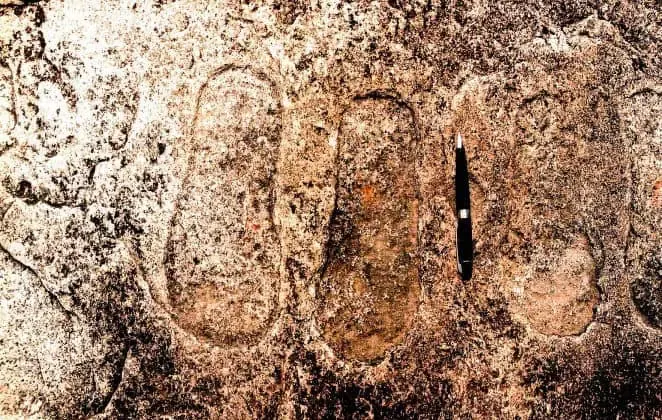
The impressions, located on exposed granite formations and associated with local folklore surrounding the Hindu figures Lord Rama and Lakshmana, have circulated for years within alternative archaeology circles. According to regional traditions, the figures are said to have passed through the area during the events described in the Ramayana, leaving footprints impressed into the stone itself.
What has reignited interest in the site is the claim that nearby carvings resemble airborne objects or disc-like symbols positioned adjacent to the footprints. Proponents of the ancient astronaut hypothesis argue that the imagery could represent an early attempt by ancient people to depict “sky beings” arriving from above. Supporters point in particular to the unusual juxtaposition of sandal-like footprints and circular engravings as evidence the imagery was intended to be read as a connected scene.
Mainstream archaeology, however, offers a far more cautious interpretation.
Footprint motifs carved or engraved into rock surfaces are extremely common across ancient cultures and are widely recognised as part of long-standing ritual and symbolic traditions. Academic studies examining prehistoric footprint imagery in India have documented numerous examples associated with ceremonial practice, spiritual symbolism, territorial marking and ancestor veneration.
Researchers studying Indian rock art note that human footprint representations appear across multiple regions and periods, often connected to sacred geography or religious continuity stretching into the present day. In Buddhist and Hindu traditions alike, footprints embedded in stone frequently function as symbolic markers associated with holy figures rather than literal impressions left physically in rock.
The geologist cited in the renewed claims reportedly suggested the markings may have been intentionally created by ancient communities to commemorate revered visitors or deities rather than naturally formed impressions. Even within that interpretation, however, there is no accepted archaeological evidence linking the site to extraterrestrial visitation or advanced lost civilisations.
The debate touches on a much larger and older Fortean question: why do cultures across the world repeatedly preserve stories of divine beings descending from the sky, often accompanied by strange symbols, lights or anomalous events?
Ancient astronaut researchers argue these recurring motifs point toward misunderstood encounters with technologically advanced visitors in the remote past. Critics counter that such interpretations often ignore the symbolic, religious and mythological frameworks within which ancient peoples understood the world.
Adding further complexity is the fact that footprint symbolism appears globally. Archaeological literature documents footprint petroglyphs and sacred foot-impressions across Europe, Africa, Australia and Asia, many carrying associations with power, rulership, initiation or spiritual presence.
For now, the Indian footprint site remains suspended between folklore, archaeology and speculation. No peer-reviewed evidence supports the extraterrestrial interpretation, yet the imagery itself continues to provoke fascination precisely because it sits in that uneasy territory where myth, ritual and unexplained symbolism overlap.
Whether the carvings represent sacred markers, commemorative art, misunderstood ritual iconography or something more exotic, the enduring mystery reflects a broader truth about humanity’s oldest stories: across cultures and millennia, people have repeatedly looked to the sky when attempting to explain the extraordinary.