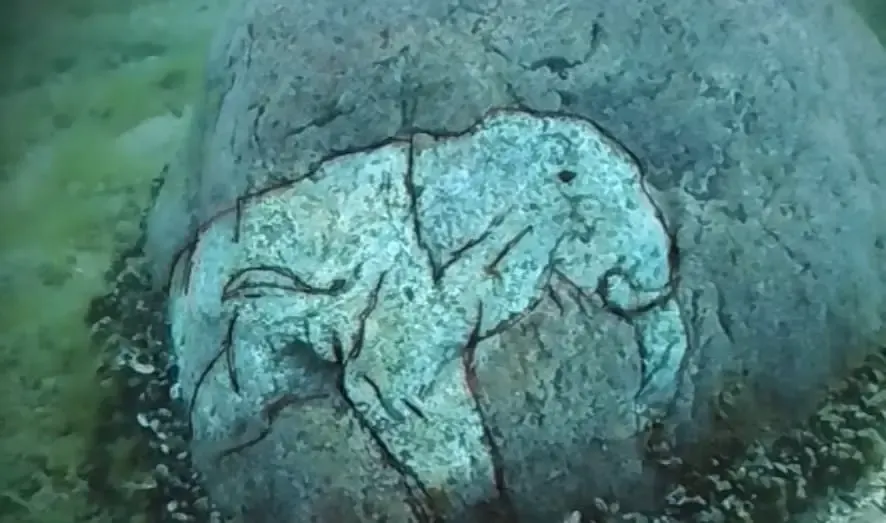
Researchers investigating a submerged prehistoric site in Lake Michigan have renewed interest in one of North America's most unusual archaeological discoveries after re-examining a stone bearing what appears to be the carving of a mastodon.
The stone was discovered at an underwater site in Grand Traverse Bay, where archaeologists have identified a series of stone formations often compared to a submerged "Stonehenge." The site lies beneath approximately 40 feet of water and is believed to date to a period when water levels in the Great Lakes were significantly lower than they are today.
The most controversial find remains a large stone bearing markings that some researchers interpret as a depiction of a mastodon, an Ice Age relative of the elephant that disappeared from North America around 11,000 years ago. If the carving is genuinely human-made and does represent a mastodon, it would suggest the stone was created at a time when both humans and mastodons occupied the region.
The underwater structure itself was first identified by Northwestern Michigan College professor Mark Holley during a sonar survey. Researchers subsequently documented a line of stones arranged in a manner that appeared deliberate rather than natural. Some archaeologists believe the formation may have functioned as a prehistoric hunting drive, designed to funnel migrating caribou into a confined area where hunters could more easily intercept them.
That interpretation would place the site among a growing number of submerged prehistoric landscapes being discovered around the world. During the last Ice Age, vast areas of land now hidden beneath lakes and oceans were exposed as sea levels were dramatically lower. As glaciers retreated and ice sheets melted, rising waters inundated ancient coastlines, river valleys and human settlements, preserving fragments of forgotten landscapes beneath the water.
The Lake Michigan discovery has inevitably attracted interest from researchers exploring the possibility of advanced pre-Ice Age civilisations. However, most mainstream archaeologists draw a distinction between evidence for ancient human occupation and claims of lost high civilisations. The archaeological record clearly demonstrates that humans occupied large parts of North America before the end of the last Ice Age, but evidence for technologically advanced civilisations predating known history remains highly controversial.
Even so, recent discoveries have challenged older assumptions about prehistoric societies. Sites such as Göbekli Tepe in modern Turkey have demonstrated that large-scale monumental construction occurred thousands of years earlier than previously believed. Meanwhile, submerged structures and palaeolandscapes identified off the coasts of Europe, Asia and the Americas continue to reveal that significant portions of humanity's prehistoric story now lie underwater.
The Yonaguni Monument off the coast of Japan, examined in Mystery of the Yonaguni Monument: Man-Made Ruins or Natural Formation?, presents the same forensic problem as the Mastodon Stone a submerged structure whose geometry implies human intention but whose depth implies a date that predates accepted human civilisation in that region, forcing a choice between revising the archaeology or dismissing the evidence.
Some researchers have pointed to these discoveries as evidence that archaeologists may still underestimate the complexity of Ice Age cultures. Others caution that extraordinary claims require direct evidence and that many underwater anomalies ultimately prove to be natural geological formations.
For now, the Lake Michigan mastodon stone remains an intriguing puzzle. Whether it represents prehistoric artwork, a coincidental natural pattern or evidence of a much older chapter of North American history, the discovery continues to generate debate more than two decades after it was first identified.
As underwater archaeology expands and new technologies allow researchers to explore drowned landscapes in greater detail, sites like Grand Traverse Bay are likely to remain at the centre of a wider question: how much of humanity's earliest history still lies hidden beneath the waters that rose at the end of the Ice Age?
Source JaySea Archeology