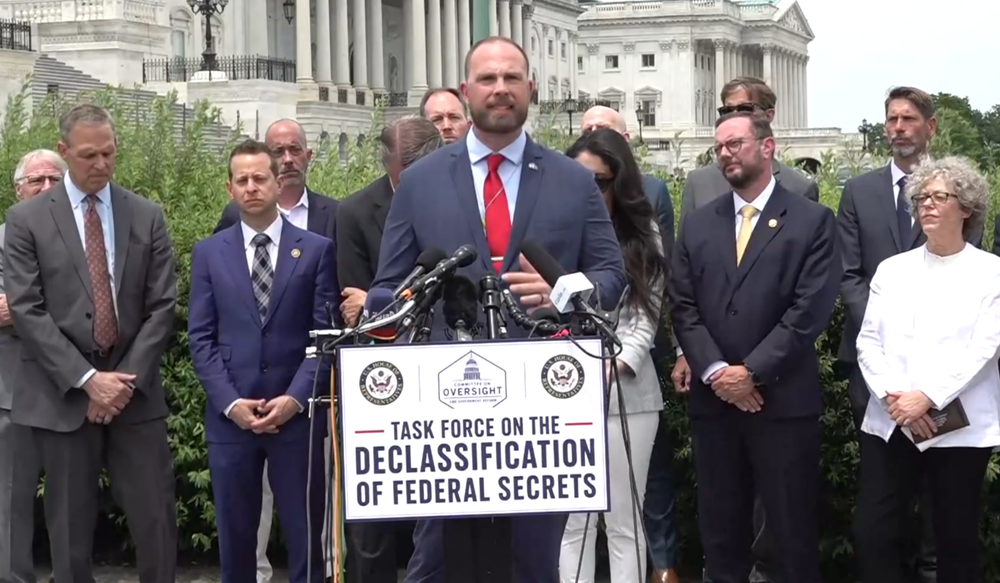
David Grusch, the former intelligence officer whose allegations of secret UFO retrieval programmes helped reignite the modern disclosure movement, returned to Capitol Hill this week as lawmakers renewed calls for greater transparency surrounding unidentified anomalous phenomena (UAPs).
The appearance on June 9, 2026, marked Grusch's most visible return to Washington since his explosive 2023 congressional testimony, when he alleged that elements of the U.S. government and defence contractors were operating highly classified programmes tasked with recovering and studying craft of unknown origin. Those claims attracted international attention and helped propel the UAP issue from the fringes of public debate into mainstream political discussion.
Appearing alongside Representatives Anna Paulina Luna, Tim Burchett, Eric Burlison and Jared Moskowitz, Grusch joined a press conference focused on government transparency, whistleblower protections and the release of additional UAP-related records. The event did not feature new allegations comparable to those made during his 2023 testimony. Instead, it centred on ongoing efforts to secure greater public access to information surrounding decades of government investigations into unexplained aerial phenomena.
The renewed push comes at a time when public interest in the subject remains unusually high. Since 2017, a series of Pentagon acknowledgements, Navy pilot encounters and congressional investigations have transformed the way the UAP issue is discussed within government circles. What was once routinely dismissed as a fringe topic is now the subject of dedicated reporting offices, intelligence reviews and bipartisan congressional scrutiny.
For Grusch's supporters, the central issue remains accountability. They argue that if classified UAP programmes exist, elected representatives and oversight bodies should have access to that information regardless of the ultimate nature of the phenomenon. The question, they contend, is not simply whether non-human technology exists, but whether government agencies have properly informed Congress about activities carried out in the name of national security.
Critics remain unconvinced. While Grusch's credentials and intelligence background have lent weight to his claims, no publicly available physical evidence has yet emerged that conclusively demonstrates the existence of recovered non-human technology. Government reviews, including investigations conducted by the Pentagon's All-domain Anomaly Resolution Office, have stated that no evidence has been found supporting allegations of secret alien spacecraft retrieval programmes.
Yet the debate refuses to disappear.
Part of the reason lies in the historical backdrop against which the controversy unfolds. The Cold War produced a vast network of compartmentalised programmes, black budgets and highly classified aerospace projects, many of which remained hidden from public view for years or even decades. For disclosure advocates, that history demonstrates that significant secrecy is possible. For sceptics, it illustrates how rumours and misunderstandings can develop around legitimate classified activities.
The return of Grusch to Capitol Hill suggests that lawmakers from both parties believe the issue remains unresolved. Whether future investigations ultimately uncover evidence of hidden programmes or simply provide greater clarity regarding past government activities, the demand for answers shows little sign of fading.
More than two years after his original testimony, Grusch remains one of the most consequential figures in the modern UAP debate. His latest appearance may not have delivered new revelations, but it underscored a growing reality in Washington: the question of what the government knows about unidentified phenomena is no longer going away.