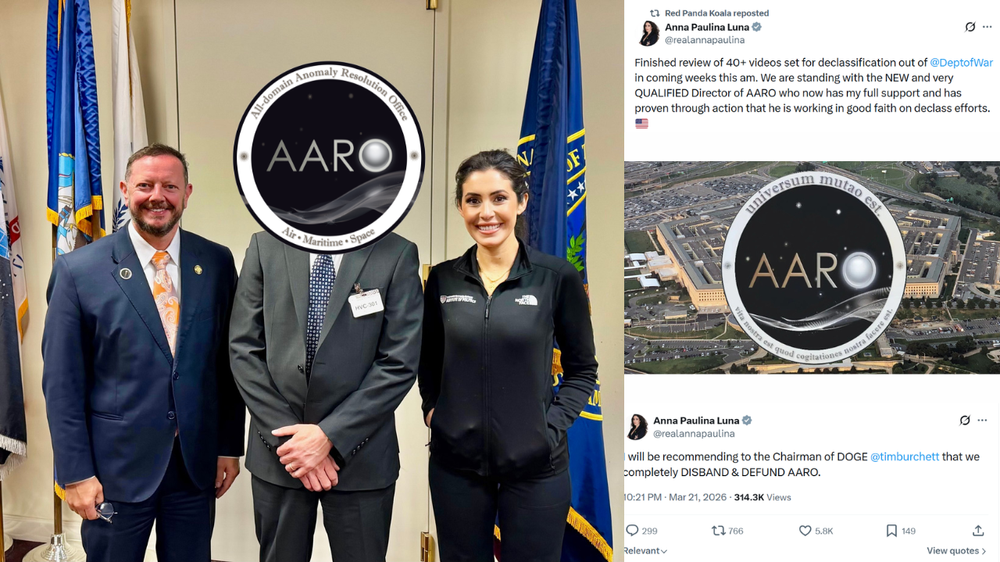
Congresswoman Anna Paulina Luna has voiced her strong support for the new director of the Pentagon’s All-domain Anomaly Resolution Office (AARO) following a year marked by contentious criticism and public scrutiny. The endorsement comes as the Pentagon prepares for a significant release of over forty previously unseen UFO videos, signalling a potential shift towards greater transparency on unidentified aerial phenomena (UAP). Concurrently, the CIA has reportedly withdrawn certain declassification files related to historic UFO investigations, while the Search for Extraterrestrial Intelligence (SETI) has entered into a partnership with Steven Spielberg’s Disclosure Day initiative, aiming to foster broader public engagement with the subject. These developments illustrate a dynamic and evolving landscape within the US government’s and scientific community’s approach to UAP research.
Luna’s backing of the AARO director is significant given the office’s mandate to investigate and assess UAP encounters across military and civilian domains. Over the past year, AARO faced criticism around its leadership and methodology, with detractors questioning the transparency and rigor of its investigations. Luna emphasised the director’s commitment to maintaining thorough, unbiased analysis despite political and public pressures. The Pentagon’s imminent release of dozens of UFO videos is expected to include military-captured footage attributed to UAP encounters, potentially substantiating claims previously relegated to fringe discourse. However, the CIA’s move to pull some UFO-related declassification files complicates the narrative, raising questions about what may remain concealed. SETI’s collaboration with Spielberg’s Disclosure Day aims to promote serious scientific discussion while leveraging public interest heightened by the entertainment industry’s focus on extraterrestrial phenomena.
Luna's endorsement of new AARO leadership is directly informed by the institutional record documented in Pattern of Disappearances Among US Defence Contractors Raises Questions Amid UAP Disclosure Delays — the disappearances of defence contractors linked to UAP research are precisely the kind of accountability failure that prompted congressional calls for AARO to be restructured under independent oversight in the first place.
This renewed attention to UFOs and UAPs fits into a broader historical and cultural context. In recent years, official acknowledgment of unidentified aerial objects—especially in the US has shifted from outright denial to cautious regard, influenced in part by high-profile military sightings recorded by advanced reconnaissance technology. AARO represents a formalised government effort to handle these encounters systematically, reflecting concerns about national security and aerospace safety rather than solely speculative extraterrestrial origin theories. The collaboration between SETI, a scientific body dedicated to detecting extraterrestrial intelligence, and media-driven activities like Disclosure Day reveals an intriguing melding of science, government disclosure efforts, and popular culture. Meanwhile, the CIA’s selective release of documents echoes past patterns of classified government programmes controlling the flow of UFO-related information, suggesting that full transparency remains elusive. Understanding this evolving dynamic is crucial for contextualising ongoing investigations and public discourse around UAP phenomena.
Source: UFO News